Real-time shop floor monitoring is the answer to that pressure. But its value only materializes when it moves decisions from end-of-shift reports to in-the-moment corrections. The difference between catching a problem during a shift and discovering it after is the difference between a minor disruption and a scrapped batch.
This article covers what real-time shop floor monitoring actually does, the three operational advantages it delivers, and what manufacturers lose when it's absent.
Key Takeaways
- Real-time shop floor monitoring tracks machine status, operator activity, and job progress at the same time — giving supervisors a complete, live picture of the floor.
- Its primary value is speed: problems caught during production cost far less than problems found at shift end.
- Unified visibility across machines, operators, and jobs removes the coordination guesswork that multiplies with each additional work order.
- Accurate job costing depends on captured data — standard estimates drift further from reality with every shift.
- Monitoring only delivers value when the data drives consistent action — not just dashboard views that go unread.
What Is Real-Time Shop Floor Monitoring?
Real-time shop floor monitoring is the continuous collection and display of production data — machine status, cycle times, job progress, operator activity, production counts — as it happens on the factory floor. Managers and supervisors see current conditions, not a historical snapshot from hours ago.
It applies wherever multiple machines, operators, and jobs run simultaneously. In those environments, a delay in spotting a problem translates directly into scrap, rework, or a missed delivery commitment.
Monitoring is only valuable when the data triggers decisions. The goal is faster corrections — not data collection for its own sake. Done right, real-time visibility drives:
- Faster problem response before scrap accumulates
- Better scheduling based on actual machine and job status
- More accurate job costing from live operator and cycle data
Three Key Advantages of Real-Time Shop Floor Monitoring
The advantages below are grounded in operational outcomes manufacturers actually track: cost, throughput, quality, labor efficiency, and job costing accuracy.
Advantage 1: Proactive Problem Detection
The ability to identify deviations — machine downtime, cycle time overruns, quality anomalies, operator delays — while a shift is still running, rather than discovering them afterward.
Sensors and data collection tools flag when a machine goes idle unexpectedly, when a job is running behind schedule, or when a production rate drops below target. That information reaches supervisors immediately rather than hours later.
The cost of delayed detection:
The cost of a production problem scales directly with how long it goes undetected. A machine stoppage caught in five minutes is a minor disruption. The same stoppage discovered at shift end can mean scrapped batches, missed orders, and cascading schedule delays.
ABB's 2023 survey of 3,215 plant maintenance decision-makers found that over two-thirds of industrial businesses experience unplanned outages at least once per month, with a median cost of $125,000 per hour. The same research found that 21% of facilities still operate on a run-to-fail maintenance model — meaning problems aren't addressed until equipment stops entirely.
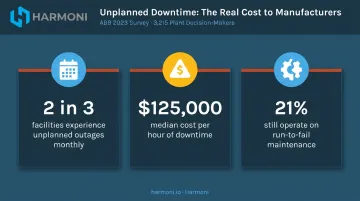
Real-time alerts allow supervisors to dispatch maintenance, adjust job sequencing, or reallocate operators before the problem compounds. That's a direct impact on cost and on-time delivery.
KPIs this affects:
- Unplanned downtime frequency and duration
- Scrap and rework rates
- On-time delivery performance
- Mean time to respond to production issues
When it matters most: High-mix, low-volume environments where each job has unique setup requirements and a single unexpected delay ripples through the entire schedule. Also critical in aerospace, defense, and precision manufacturing where scrap costs on a single part can exceed the entire margin on a job.
Advantage 2: Unified Visibility Across Machines, Operators, and Jobs
A complete, real-time operational picture that combines machine status, what each operator is doing, and the progress of every active job — rather than monitoring machines in isolation while operator activity remains invisible or manually tracked.
Platforms that pull data from machine controls, operator inputs, and ERP work orders into a single unified view eliminate the need for supervisors to walk the floor collecting status updates or wait for operators to manually log job completions.
The visibility gap machine data alone can't close:
Machine utilization data alone tells only part of the story. A machine showing as "running" may still be producing scrap, waiting for material, or running the wrong program. Adding operator activity and job context reveals what's actually happening versus what the machine signal suggests.
The gap between reported utilization and actual productive output is measurable. Modern Machine Shop's 2024 Top Shops data shows that 85% spindle utilization — meaning in-cut time as a percentage of total machine uptime — sits at only the 83rd percentile. Most shops are running well below that. Vorne's OEE benchmarking puts typical manufacturer OEE at 60%, with world-class performance at 85%.
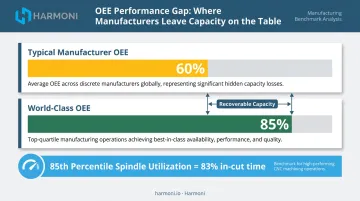
That spread represents capacity that already exists on the floor — recoverable without adding a single machine.
How operator accountability connects: When operators know their activity is tracked in real time, process adherence improves. When managers can see operator-to-job assignments live, labor allocation becomes data-driven rather than instinctive. Harmoni's factory orchestration platform is built on this principle — combining machine data, ERP work order context, and live operator activity via long-range RFID into a unified view at each workcenter, so supervisors see the full picture rather than fragments of it.
KPIs this affects:
- Machine utilization rate
- Operator utilization
- Labor efficiency
- Work-in-process (WIP) accuracy
- Job completion rate versus schedule
When it matters most: As the number of active work orders and machines scales up, coordination complexity increases faster than any supervisor can manage manually. In shops running 20+ machines with mixed operator assignments, a unified real-time view becomes essential — not convenient.
Advantage 3: Accurate Job Costing and Labor Visibility
The ability to capture actual time-on-job data — per operator, per machine, per work order — in real time, rather than relying on estimated cycle times or end-of-shift manual logs that are often incomplete or rounded.
When job start and stop times, operator assignments, and machine cycles are recorded automatically as production happens, the actual cost to complete each job becomes a measured fact rather than a standard estimate.
Where margin actually disappears:
Inaccurate job costing is a direct profitability risk. Manufacturers who rely on standard cost estimates rather than actual captured data often underprice jobs or fail to identify which product lines are eroding margin. Each quote built on inaccurate actuals drifts further from reality — and over time, the cumulative effect is invisible margin loss.
NIST notes that manufacturing execution systems provide the real-time data needed to recognize when inefficiencies occur and create embedded costs — but only when that data is captured at the job level, not just at the machine level.
What this enables strategically:
- Quoting accuracy for future work based on what jobs actually cost
- Identification of which machines or processes carry the highest cost per part
- Clear visibility into where process improvements would have the greatest financial return
Harmoni captures this by automatically combining machine cycle time with RFID-based operator labor records, producing job cost data that reflects what production actually cost rather than what was estimated at planning.
KPIs this affects:
- Actual vs. standard cost variance
- Labor efficiency ratio
- Job profitability by work order
- Quote-to-actual deviation
- Direct labor hours per part
When it matters most: Contract manufacturing and job shop environments where each order is uniquely priced and quoting accuracy is a direct competitive differentiator. Also critical for companies evaluating capacity expansions or equipment investments, where knowing the true cost of current operations is foundational to the business case.
What Happens Without Real-Time Monitoring
Without real-time monitoring, the shop floor runs on lagging information. Correctable problems go unaddressed until they've compounded into locked-in losses — and by then, the damage is already done.
Here's what that looks like in practice:
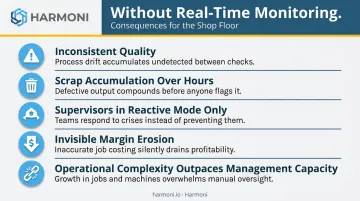
Results vary shift to shift when there's no visibility into whether operators are following the correct process or machines are running at target parameters. Quality issues go undetected until inspection catches them, often after a full batch has been produced.
Problems that take minutes to correct in real time go unaddressed for hours, accumulating scrap that directly inflates per-part costs.
Supervisors spend their shifts responding to problems that have already escalated — expediting jobs, explaining late shipments, negotiating with customers — instead of staying ahead of disruptions.
Without accurate job cost data, estimates stay anchored to standards rather than actuals. Over time, that makes it impossible to identify and eliminate the specific jobs or processes eroding margin.
What was manageable by walking the floor at 10 machines becomes operationally invisible at 30. Complexity grows faster than management capacity when there's nothing feeding real-time data back to the people running the operation.
How to Get the Most from Real-Time Shop Floor Monitoring
Real-time monitoring delivers measurable returns when the data it captures drives consistent action — not just views, but changes to how supervisors intervene, how jobs are scheduled, and how costs are estimated.
Three conditions determine whether monitoring creates lasting value:
Apply it consistently across all workcenters and shifts. Partial monitoring creates blind spots. Problems don't disappear in unmonitored areas — they just become invisible until they've already caused damage.
Review insights at regular shift-level intervals. End-of-shift performance reviews using monitoring data keep teams aligned on what went wrong, what caused it, and what changes to make on the next shift. Waiting for a monthly report means acting on information that's weeks old.
Connect the monitoring layer to ERP and operator workflows. Data should flow in both directions: production actuals feed back into job cost records, schedule adherence is visible against planned work orders, and operators receive job-level instructions in the same system that captures their activity.
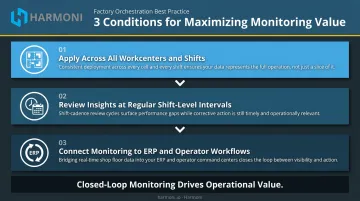
All three conditions point toward the same requirement: a platform that closes the loop rather than just opening a data stream. Harmoni, which operates as a factory orchestration layer between ERP systems, machines, and operators, is built specifically for closed-loop monitoring — where production actuals flow back into job records and operator actions connect directly to ERP transactions. Collecting data is straightforward; connecting that data to the decisions it should inform is where the operational value actually comes from.
Conclusion
Real-time shop floor monitoring gives manufacturers control, clarity, and consistency over operations that are inherently complex and fast-moving. The data matters because of what it makes possible: faster decisions, earlier interventions, and cost visibility that holds up at the job level.
The three advantages covered here — proactive problem detection, unified visibility across machines and operators, and accurate job costing — compound over time. That compounding only happens when monitoring is applied consistently and connected to the systems that actually drive production decisions.
Treat it as an ongoing operational practice, not a one-time implementation. The manufacturers who extract the most value use each shift's data to improve the next — narrowing the gap between what was planned and what actually ran.
Harmoni's factory orchestration platform connects machine data, operator activity, and ERP workflows into a single real-time view — so the monitoring you put in place doesn't sit in a dashboard. It drives decisions. See how it works with a free demo at harmoni.io/demo.
Frequently Asked Questions
What is a shop floor monitoring system?
A shop floor monitoring system is a digital platform that continuously collects and displays production data — from machines, operators, and jobs — giving plant managers real-time visibility into factory floor activity. It lets teams identify and correct issues as they occur, rather than discovering scrap, rework, and schedule losses after the fact.
How does an MES differ from a shop floor control system?
Shop floor control focuses on the execution layer — tracking work orders, job status, and production data in real time. An MES is broader, potentially including quality management, compliance documentation, multi-site orchestration, and traceability. The terms are often used interchangeably, but the practical difference comes down to scope: shop floor control executes; MES manages the broader production environment around it.
What data does a real-time shop floor monitoring system collect?
The main data types include machine operational status, cycle times, production counts, operator activity and job assignments, downtime events and reasons, and job progress against the production schedule.
How does real-time shop floor monitoring reduce production costs?
It reduces costs in two ways. First, faster detection of downtime, quality deviations, and process errors limits the scrap and rework that accumulate when problems go unnoticed. Second, capturing actual labor and cycle time data per job enables accurate job costing — preventing underpricing and revealing where process improvements deliver the greatest financial return.
Can real-time shop floor monitoring integrate with existing ERP systems?
Modern shop floor monitoring platforms integrate directly with ERP systems so that work order data, job schedules, and production actuals flow between both systems in real time. This eliminates manual data re-entry and ensures job cost records reflect what actually happened on the floor, not just planned estimates.
What KPIs should manufacturers track with shop floor monitoring?
The most operationally significant metrics are machine utilization and unplanned downtime, OEE (Overall Equipment Effectiveness), on-time job completion rate, scrap and rework rates, actual vs. standard labor hours per job, and operator utilization. The most valuable KPIs are those tied directly to cost and delivery performance — not just machine activity.