Introduction
Manufacturers today are squeezed from multiple directions: raw material costs expected to rise 5.5% over the next year according to NAM's Q1 2025 Outlook Survey, rising part complexity, workforce gaps, and customer quality expectations that have zero tolerance for reactive problem-solving.
Most manufacturers know they need to digitize the shop floor. Many have tried — dashboards installed, ERP modules added, maybe a machine monitoring tool bolted on. And yet the execution gap persists.
The gap between what the ERP says should happen and what operators are actually doing is where real costs accumulate: missed schedules, unplanned scrap, and quality escapes that shouldn't have made it past the floor.
That gap is exactly what this article addresses — what digital shop floor management actually delivers, operationally, when applied consistently, and where manufacturers feel the impact first.
Key Takeaways
- Digital shop floor management replaces paper-based delays with real-time coordination of machines, operators, and ERP data
- The three measurable advantages: production visibility, eliminated operator downtime, and proactive error prevention
- Platforms like Harmoni unify machine, operator, and ERP data in a single view — no system-hopping required
- Without it, managers react to problems that have already cost time, material, or quality
- The value compounds when treated as an ongoing operational discipline, not a one-time software rollout
What Is Digital Shop Floor Management?
Digital shop floor management is the real-time coordination of production operations — connecting machines, operators, work instructions, and ERP data so that managers and workers have accurate, live information at every workstation.
It applies wherever there's a gap between what planning systems say should happen and what operators are actually executing. That gap is most costly in:
- CNC machining and job shops with frequent changeovers
- Multi-step manufacturing processes where errors compound across operations
- High-mix, low-volume environments where every job is different
- Multi-shift operations where information handoff between shifts breaks down
Digital shop floor management is not a system you install and forget. Its value lies entirely in what it prevents — errors, idle time, miscommunication — and what it enables: faster decisions, consistent process execution, and accurate tracking.
A platform that sits between ERP systems, machines, and operators reduces the integration burden by connecting existing systems. But it only delivers real value if it changes how decisions get made on the floor.
Key Advantages of Digital Shop Floor Management
The three advantages below reflect operational outcomes manufacturers actually track. Each is tied to specific KPIs and conditions where the impact lands hardest.
Real-Time Production Visibility
Real-time production visibility means knowing the live status of every job, machine, and operator on the floor — updated continuously, not hours after the fact.
In analog or siloed environments, problems surface during end-of-shift reviews. By then, parts may already be scrapped, a deadline may already be missed, and the root cause is hours removed from its evidence. That discovery lag is the core problem.
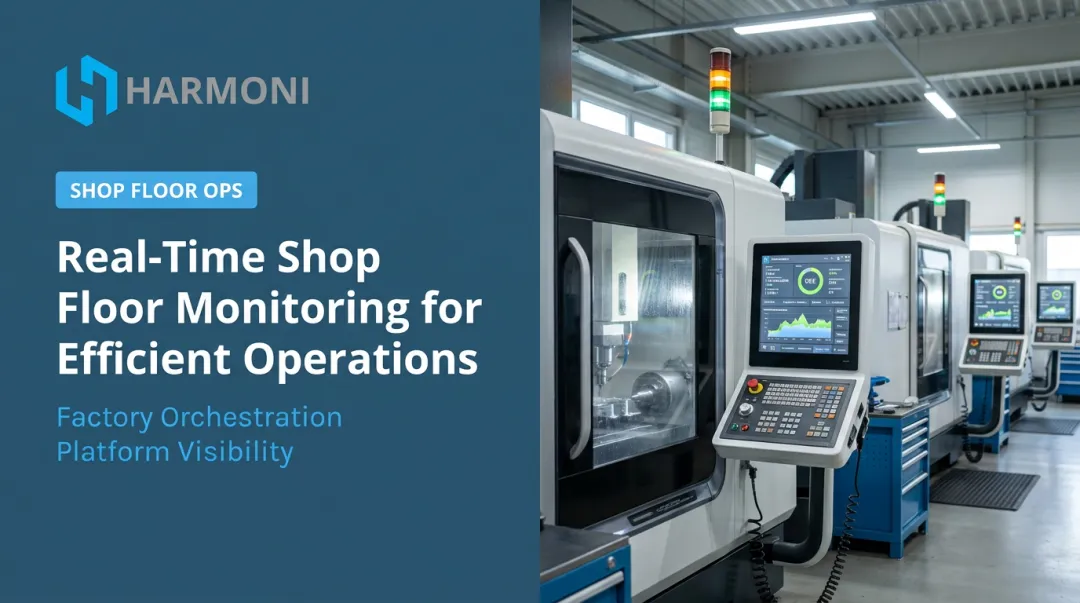
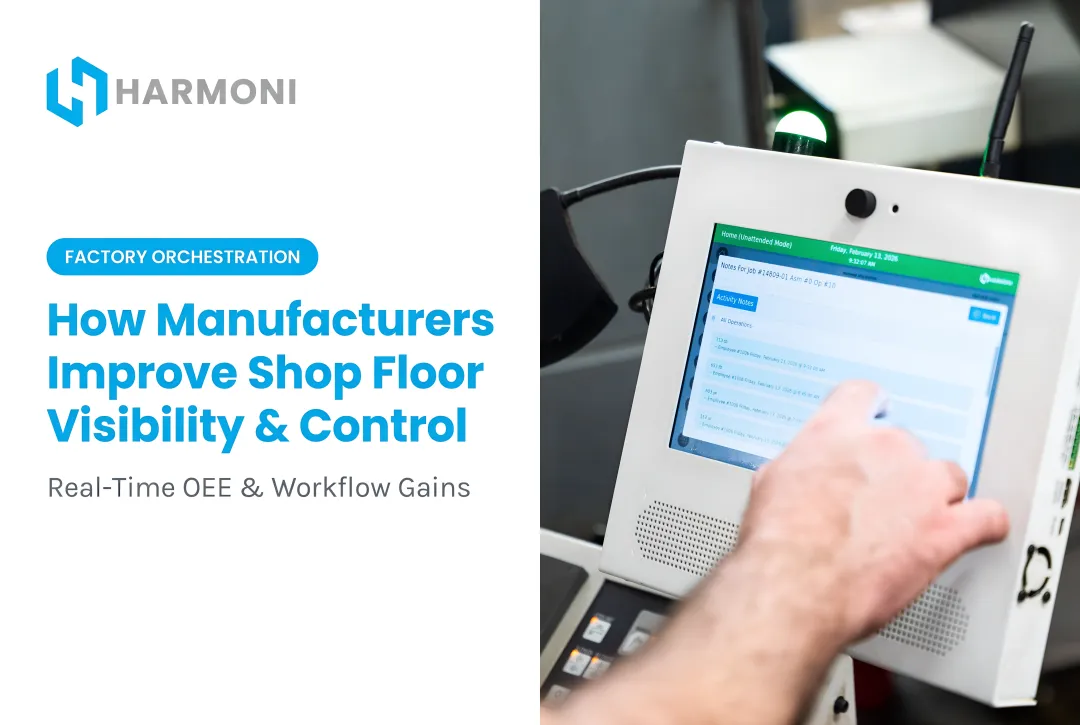
Platforms like Harmoni collapse that lag by pulling machine data, operator activity, and ERP job status into unified dashboards that update in real time. Supervisors can identify deviations the moment they occur and act before damage accumulates — rather than reconstructing what went wrong from shift logs.
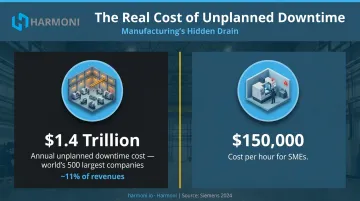
The financial stakes are real. Siemens' 2024 downtime research found that unplanned downtime costs the world's 500 largest companies $1.4 trillion annually — roughly 11% of revenues. For SMEs specifically, costs can reach $150,000 per hour. Even at a fraction of that scale, a mid-size job shop running on tight margins absorbs the same structural risk.
When supervisors have live data, they can reroute jobs, redeploy operators, or escalate machine alerts without guessing. That shift from reactive to proactive is where real efficiency gains accumulate.
KPIs impacted:
- OEE (Overall Equipment Effectiveness)
- Machine utilization rate
- Mean time to detect (MTTD) production deviations
- On-time delivery rate
- Supervisor response time to floor exceptions
When this matters most: High-mix, low-volume environments with frequent job changeovers, and multi-shift operations where inconsistent information handoff creates blind spots at shift transitions.
Elimination of Wasted Operator Time
Wasted operator time is any minute spent not making parts: walking to find a supervisor, waiting for a job assignment, manually logging start and stop times on paper. Add hunting for the correct work instruction revision or re-entering data that already lives in the ERP, and the losses compound quickly.
These minutes are invisible in most shops because they're never measured. But they add up fast.
WessDel, a manufacturing customer of Harmoni, conducted time studies and found operators were spending 11 minutes per ERP transaction — clocking in, changing jobs, logging time — multiple times per shift. After implementing Harmoni's RFID-based automation at the machine side, those same transactions dropped to seconds. The result: 17 additional productive hours per employee per month, with a 5X return on ongoing system costs.
At that scale, recovering 17 hours per employee per month represents a structural reallocation of labor capacity — not a marginal tweak.
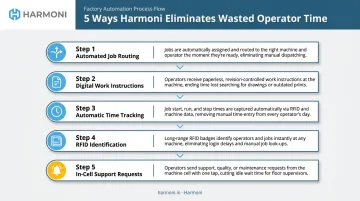
That recovery comes from targeted automation built into the workflow:
- Automated job routing delivers the right job to the right workstation when it's ready
- Digital work instructions pull the correct revision from the ERP and display it at the machine
- Time tracking is captured automatically — no manual entry required
- RFID-based identification eliminates manual logins and job selection steps
- Operators initiate support requests from the machine terminal without leaving the work cell
Why job costing accuracy matters here: When time-on-job is captured automatically rather than estimated or self-reported, job costing data becomes reliable. Shops discover which jobs are profitable and which are absorbing unexpected labor cost — something that's nearly impossible to know when operators are guessing at hours on paper travelers.
KPIs impacted:
- Labor efficiency ratio
- Actual vs. estimated job hours
- Operator utilization rate
- Non-productive time per shift
- Cost-per-part accuracy
When this matters most: High-labor-cost environments, multi-machine operations where operators manage several work centers, and shops with significant job variation where wrong revision use is a persistent risk.
Proactive Error Prevention and Process Control
Proactive error prevention means enforcing the correct process steps, approvals, and checkpoints digitally — so deviations are caught at the point they occur, not discovered during downstream inspection.
Scrap and rework are among the most expensive outcomes in precision manufacturing. They're also largely preventable if the deviation is caught early. APQC benchmarking via ASQ shows top-performing manufacturers spend 0.6% of sales on scrap and rework — versus 2.2% for bottom performers. That gap reflects how well operations enforce process standards before failure happens.
Process control logic embedded directly in the workflow drives that difference:
- Quality checks trigger automatically at defined intervals
- Alerts fire when a machine parameter drifts, cycle time exceeds target, or an operator skips a required step
- Supervisors receive escalations immediately — Harmoni's exception alert system allows managers to directly contact the work cell and operator from their desk without walking the floor
- Real-time checksheet data lets both operators and managers detect out-of-tolerance production cycles before they become scrap events
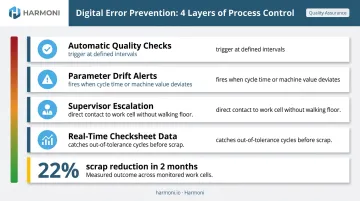
One customer reduced scrap 22% in just two months after Harmoni deployment.
Why this matters in regulated manufacturing: In aerospace, defense, and medical device production, digital process enforcement provides an auditable, timestamped record of every step. A new operator following a digital checklist produces the same outcome as a veteran — which is exactly what AS9100, ISO 13485, and CMMC-aligned environments require. It also means audit exposure drops when records exist automatically rather than through manual documentation.
KPIs impacted:
- Scrap rate and rework rate
- First-pass yield
- Cost of poor quality (COPQ)
- Customer return rate
- Audit finding frequency
When this matters most: Regulated sectors (aerospace, defense, medical device), high-precision environments where tolerance deviations are costly, and shops with high operator turnover where process adherence can't depend solely on experience.
What Happens When Digital Shop Floor Management Is Missing
The pattern is consistent across shops that rely on paper travelers, whiteboard scheduling, and manual time entry: decisions get made on information that's hours old, problems surface after they've already consumed material or time, and managers spend their shifts reacting instead of leading.
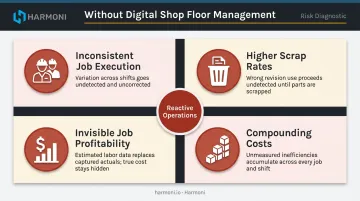
The specific consequences:
- Inconsistent job execution — operators on different shifts interpret instructions differently, producing variation that shows up in quality or rework
- Higher scrap rates — wrong revision use and skipped steps go undetected until inspection
- Invisible job profitability — when labor data is estimated rather than captured, there's no reliable way to know which jobs make money
- Compounding costs — inefficiencies that go unmeasured don't get fixed; they accumulate
The scaling problem is where this gets serious. As order volume, product mix, and workforce size grow, analog shop floor management doesn't scale with them. The information gaps widen, firefighting intensifies, and the cost of errors rises proportionally.
A 10-person shop can manage these gaps through tribal knowledge and proximity. A 50-person, multi-shift operation cannot. The information surface area is too large, and the stakes of each missed signal are too high.
Without real-time visibility, every improvement effort is reactive — built on guesses rather than data, and limited to problems someone happened to notice.
How to Get the Most Value from Digital Shop Floor Management
Digital shop floor management delivers compounding value when three conditions are met:
- Consistent application — deployed across all work centers and shifts, not just one area or one supervisor's domain
- Regular review of live data — OEE reviewed at the start of each shift, deviations escalated immediately, process checkpoints enforced
- Measurement baselines defined before deployment — set target cycle times, acceptable scrap rates, and labor efficiency targets before go-live so you can identify and sustain improvements — without a baseline, measuring impact is nearly impossible
The technology piece matters less than most vendors suggest. Harmoni's factory orchestration platform deploys in weeks without requiring machine replacement or ERP swap-out — it retrofits to existing equipment and integrates with ERPs including Epicor, Infor, JobBoss, ABAS, and ODOO. That reduces the deployment barrier considerably.
A platform that sits underused — because no one reviews the data or acts on the alerts — delivers nothing.
The discipline of reviewing real-time data and acting on it daily is what separates manufacturers who see measurable results from those who don't.
Frequently Asked Questions
What is digital shop floor management?
Digital shop floor management is the real-time coordination of machines, operators, work instructions, and ERP data on the production floor. It replaces paper records, manual logging, and delayed reporting with live visibility that allows managers and operators to respond to deviations as they occur — not after costs have already been incurred.
What are the 5S in shop floor management?
The 5S methodology — Sort, Set in Order, Shine, Standardize, Sustain — is a Lean tool for organizing and maintaining a clean, efficient workplace. In digital environments, 5S compliance is enforced through digital audit checklists and visual management dashboards, making adherence trackable against completion targets rather than reliant on manual inspection rounds.
How do you increase productivity on the shop floor?
Productivity increases when non-productive operator time is eliminated, process steps are enforced consistently, and real-time data identifies bottlenecks before they cascade. Digital shop floor management addresses all three: it automates job routing and time capture, delivers correct work instructions at the machine, and alerts supervisors to deviations the moment they occur.
What KPIs should you track with digital shop floor management?
The most important: OEE, first-pass yield, actual vs. estimated job hours, scrap rate, operator utilization, and on-time delivery rate. The qualifier that matters: any metric disconnected from daily decisions won't improve performance. Track only what your team can act on.
How does digital shop floor management integrate with ERP systems?
Modern platforms integrate bidirectionally: pulling job orders, routings, and work instructions from the ERP, then pushing actual labor hours, machine time, and completion status back in real time. This eliminates duplicate data entry and ensures ERP records reflect what actually happened on the floor — not end-of-shift operator estimates.
What is the difference between a MES and digital shop floor management?
A Manufacturing Execution System (MES) is a defined software category under ISA-95 that handles production execution transactions. Digital shop floor management is a broader operational discipline — it may use a MES, an orchestration platform, or a combination of tools, but the technology supports the management approach rather than substituting for it.