Introduction
Most manufacturing facilities are not short on data. Machines generate signals constantly — cycle times, spindle loads, temperatures, fault codes. The problem is that data sitting in a sensor is not the same as intelligence on the shop floor.
According to Siemens' 2024 True Cost of Downtime report, the world's 500 largest industrial companies lose $1.4 trillion annually to unplanned downtime — equal to 11% of total revenues. Average recovery time from a downtime incident has climbed from 49 minutes in 2019 to 81 minutes in 2024. Those numbers don't reflect a sensor problem. They reflect an intelligence problem.
IoT sensor software for real-time production monitoring addresses exactly that. The right platform doesn't just collect machine data — it transforms raw signals into production KPIs, triggers responses, and connects what machines report to what operators and managers actually do next.
Key Takeaways
- IoT sensor software provides continuous, machine-level visibility that manual tracking and post-shift reports cannot match
- Real-time monitoring delivers ROI only when sensor data is paired with operational context: operator activity, job routing, and ERP workflows
- The most effective platforms close the loop between machine signals and operator action — not just reporting problems, but driving responses
- Deployment speed and integration breadth are critical selection criteria — leading solutions go live in weeks with no machine replacement required
What Is IoT Sensor Software for Real-Time Production Monitoring?
IoT sensor software is a digital platform that connects to machines, sensors, and shop floor devices to continuously capture, transmit, and visualize production data. It gives manufacturers a live view of equipment status, cycle times, output rates, and quality signals as they happen.
Hardware vs. Software: Why the Distinction Matters
The sensors themselves — vibration sensors, current clamps, proximity switches — are hardware. They generate raw signals. The software layer is what aggregates, interprets, and surfaces those signals as something useful: dashboards, alerts, KPIs, and reports.
This distinction matters because two facilities can deploy the same sensors and get radically different results depending on the software platform. One facility gets a screen showing machine states. Another gets automated alerts, job-level cost data, and proactive scrap prevention. The hardware is similar — the software determines the outcome.
Real-Time Monitoring Within Industry 4.0
NIST describes Industry 4.0 as the shift to automating traditional manufacturing using IoT, robotics, and data analytics — where connected technologies monitor real-time performance, identify bottlenecks, predict breakdowns, and improve OEE.
Real-time production monitoring is the operational core of that shift. It moves manufacturers from reactive, post-shift reporting, where problems surface after the fact, to proactive, in-shift decision-making where problems are caught while there's still time to act.
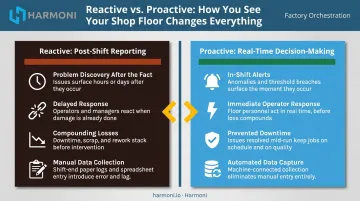
Deloitte's 2025 smart manufacturing survey of 600 executives found that smart manufacturing investments can deliver up to 20% improvement in production output and 15% unlocked capacity. Those results require closing the loop between data and action — sensor installations alone don't move the needle.
How IoT Sensor Software Collects and Processes Production Data
Sensor Types Used in Manufacturing
The most common sensor types deployed in production monitoring each answer a specific operational question:
| Sensor Type | What It Monitors |
|---|---|
| Vibration | Mechanical wear on motors, spindles, and rotating equipment |
| Temperature | Thermal conditions in cutting processes and tool wear |
| Current/Power | Machine run, idle, and fault states inferred from power draw |
| Pressure | Hydraulic and pneumatic system performance |
| Proximity/Cycle-count | Part presence, production rate, and cycle completion |
Sensor selection depends on what question the manufacturer is trying to answer. Trying to detect machine faults early? Vibration and current sensors. Trying to track cycle-rate against target? Proximity or cycle-count sensors integrated with the software platform.
IoT-enabled sensors differ from traditional instrumentation in one critical way: they transmit data wirelessly or over industrial networks to a central software platform, enabling continuous monitoring without manual data collection rounds.
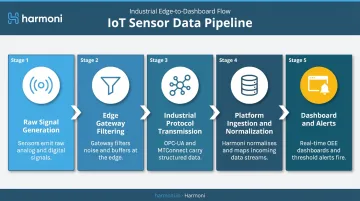
That continuous stream of sensor data only becomes useful once it moves through the right processing layers. Here's how raw signals travel from machine to dashboard:
The Data Pipeline: From Machine to Dashboard
Raw sensor data travels through several processing stages before it reaches an operator's screen:
- Sensors generate raw signals — analog or digital outputs tied to machine states and physical conditions
- Edge devices or gateways filter and pre-process the data, reducing noise and preparing it for transmission
- Industrial protocols carry the data: OPC-UA handles machine-to-enterprise interoperability, MQTT serves lightweight IoT messaging, MTConnect standardizes CNC machine data, and Ethernet/IP connects legacy programmable controllers
- The software platform ingests, normalizes, and stores the signals, transforming varied inputs into a consistent data model
- Dashboards and alerts surface the insights, delivering role-appropriate views to operators, supervisors, and managers
Edge vs. cloud processing represents a design choice with real trade-offs. Edge processing reduces latency and handles high-frequency machine signals without dependency on network connectivity. Cloud platforms offer scalability for multi-site aggregation and historical analytics. Most modern platforms use a hybrid approach: edge handles real-time signal processing, while cloud infrastructure manages reporting and long-term trend analysis.
The software layer converts raw readings into production KPIs: cycle time, machine utilization, OEE (Availability × Performance × Quality), downtime duration and frequency, and shift output vs. target.
Key Features That Define Effective IoT Production Monitoring Software
Not all platforms are equal. These are the features that separate monitoring software that actually drives results from software that just fills screens with numbers.
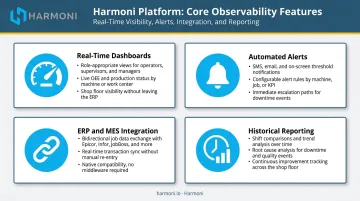
Real-Time Dashboards and Visualization
Effective dashboards are role-appropriate. Operators need workcenter-level status at a glance. Supervisors need line-level throughput. Plant managers need shift and facility-wide summaries. Look for configurable views that don't require IT involvement to maintain — because production environments change constantly.
Automated Alerts and Threshold Notifications
The software should push alerts (via SMS, email, or on-screen notification) the moment a machine deviates from expected cycle time, enters unplanned downtime, or breaches a sensor threshold. Waiting for a manager to notice a problem on a dashboard costs time that compounds quickly.
The Modern Machine Shop case study of Coastal Machine and Supply, a CNC aerospace job shop, showed cell leads receiving alerts within 15 minutes of a machine going down. That speed enabled intervention even during lights-out and weekend operations.
ERP and MES Integration
Standalone sensor data has limited operational value without connection to job orders, routings, and production schedules. Effective platforms pull job data from ERP systems and push production actuals back, supporting accurate job costing, on-time delivery tracking, and resource planning. Modern Machine Shop has documented that machine monitoring integrated with ERP reduces communication barriers and prevents errors from outdated work instructions and digital work orders.
Historical Data and Reporting
Real-time monitoring captures what's happening now. Historical data answers why it keeps happening. A capable platform delivers:
- Trend storage for shift-over-shift comparisons
- Root cause investigation across machines, jobs, and operators
- Continuous improvement tracking tied to specific process changes
- Schedulable, exportable reports for management review cycles
Scalability and Legacy Equipment Support
The software must work with the machine mix already on the shop floor, including equipment without native digital outputs. Platforms that require machine replacement to function are a non-starter for most mid-to-large facilities with mixed-age equipment.
Why Raw Sensor Data Isn't Enough: The Operational Context Gap
Sensor-only monitoring has a hard ceiling: a sensor can tell you a machine stopped, but not why.
Was the operator waiting for material? Setting up the next job? Troubleshooting a program error? Did the machine genuinely fault? Without context, downtime data is ambiguous. And without accurate root cause data, improvement efforts are guesswork.
The Three Layers of Context That Matter
Effective IoT sensor software must incorporate three layers of operational context alongside machine signals:
- Operator activity — who is at the machine, what job they are running, what steps they have completed
- Job and routing data from ERP — what the machine is supposed to produce, at what rate, by when
- Process control requirements — the work instructions, tooling specs, and quality checkpoints tied to each operation
When these layers combine with machine sensor data, entirely different outcomes become possible.
What Context-Aware Monitoring Enables
The difference between sensor data and contextualized production intelligence shows up in four concrete areas:
- Accurate job costing — actual machine time vs. estimated, tied to specific operators and job numbers
- Proactive scrap prevention — alerting operators to process deviations before a bad part is produced, not after
- Labor visibility — understanding where operator time is genuinely lost vs. productive
- Real accountability — workcenter-level data that connects outcomes to decisions
Harmoni's Factory Orchestration Approach
This is the problem Harmoni was built to solve. Rather than sitting alongside existing systems, Harmoni's factory orchestration platform sits between ERP systems, MES systems, machines, and operators — combining all three context layers into a unified real-time view.
Using long-range RFID, Harmoni automatically identifies which employee is at which workcenter and which job is active — no manual time entry required. That detection triggers a cascade of downstream actions:
- The correct CNC program loads automatically
- The right work instructions display at the machine
- Quality checksheets activate for that specific part and revision
The result: machine sensor data — spindle status, cycle time, OEE — is always paired with the job it belongs to, the operator who ran it, and the ERP routing that governs it. That combination enables accurate job costing without double-entry, scrap prevention through automated program loading, and real-time performance visibility that supervisors can act on immediately.
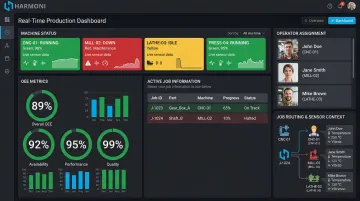
Harmoni connects natively to major CNC controls (Mazak, Haas, Fanuc, Heidenhain, Siemens, DMG MORI, Makino, Fadal) and legacy equipment without native digital outputs. It integrates with Epicor, Infor, Infor Visual, ECI JobBoss/JobBoss2, ABAS, and ODOO out of the box, and deploys in weeks without machine replacement.
Choosing and Deploying IoT Sensor Software: What Manufacturers Need to Know
Key Evaluation Criteria
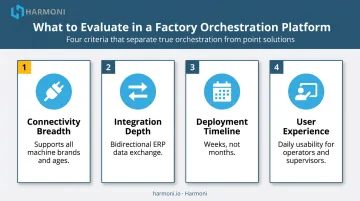
When selecting a platform, evaluate against these four criteria:
- Connectivity breadth — does it support your machine brands and ages without requiring equipment replacement?
- Integration depth — can it connect to your ERP and exchange data bidirectionally?
- Deployment timeline — does it go live in weeks, or does it require a 12-month implementation?
- User experience — will operators and supervisors actually use it daily, or will it sit idle on a screen in the corner?
Common Implementation Pitfalls
McKinsey's IIoT research notes that initial IIoT use cases can deploy in 6–8 weeks, but discrete plants face specific complications from proprietary machine interfaces and less standardized control infrastructure. The most common mistakes:
- Deploy on a subset of machines first — validate the data model before rolling out shop-wide
- Bring operators into the process early — teams that don't trust the data won't use it correctly
- Look beyond the license fee — integration effort and ongoing support can dwarf the initial cost
The recommended approach: start with high-impact or high-downtime machines, validate the data, then expand. A phased rollout gives the operations team time to build confidence in the data before using it to drive decisions.
Security and Compliance Considerations
For manufacturers in aerospace, defense, and other regulated industries, the platform must meet specific security requirements. CMMC (32 CFR Part 170) explicitly includes IoT, IIoT, and OT as specialized assets within its scope. DFARS 252.204-7012 covers safeguarding covered defense information for any system that processes or transmits it.
Verify that your platform supports:
- Role-based access control to limit data exposure by user level
- Full audit trails for traceability and compliance documentation
- Encrypted data transmission across all connections
Harmoni offers a Government Cloud deployment option for defense contractors handling Controlled Unclassified Information, providing a CUI-appropriate environment for shops with ITAR and CMMC obligations.
Frequently Asked Questions
What types of IoT sensors are most commonly used in production monitoring?
The most common types are vibration sensors (detecting mechanical wear), temperature sensors (thermal and process monitoring), current/power sensors (inferring machine run/idle/fault states), pressure sensors (hydraulic and pneumatic systems), and proximity or cycle-count sensors (tracking part presence and production rate). Sensor selection depends on the specific operational question being answered.
How does IoT sensor software integrate with ERP and MES systems?
Modern platforms use APIs, standard industrial protocols (OPC-UA, MTConnect), or pre-built connectors to exchange data with ERP and MES systems in both directions. The platform pulls job orders, routings, and schedules from ERP while pushing production actuals, labor time, and quality data back — keeping both systems synchronized.
What is the difference between IoT sensor software and an MES?
An MES manages production execution and scheduling at a system level (ISA-95 Level 3). IoT sensor software provides the real-time machine and floor-level data layer beneath it. Factory orchestration platforms sit between both, adding the operator context and machine connectivity that ERP and MES systems typically lack on their own.
What KPIs can real-time IoT production monitoring software track?
Core KPIs include OEE (Availability, Performance, and Quality), cycle time vs. target, machine utilization, downtime frequency and duration, shift output vs. target, and scrap/reject rates. Platforms with ERP integration can also track job costing accuracy and on-time delivery performance.
How long does it typically take to deploy IoT sensor software in a manufacturing facility?
Timelines vary by platform and scope. Simple plug-and-play sensor platforms can be operational in days. Full-featured platforms with ERP integration typically range from a few weeks to several months, depending on machine mix complexity and integration depth. McKinsey research cites 6–8 weeks for initial IIoT use cases.
How does real-time production monitoring help reduce scrap and production errors?
Real-time monitoring alerts operators to process deviations (cycle time drift, missed inspection steps, wrong program selection) as they happen, enabling correction before defective parts are produced. Platforms that automate program loading based on the active job and part revision eliminate one of the most common sources of scrap at the machine level entirely.