Introduction
According to Fluke's 2025 research, 55% of U.S. manufacturers experienced unplanned downtime in the prior year, with capital impact reaching up to $207M weekly. For operations teams already stretched thin, that's lost capacity on every shift — not a rounding error.
OEE (Overall Equipment Effectiveness) software has become the standard response. By measuring Availability, Performance, and Quality in real time, these platforms replace the slow guesswork of manual tracking with data operations teams can act on.
The 2026 market spans a wide range of options — from lightweight IoT dashboards that deploy in days to full factory orchestration systems that connect machines, operators, and ERP workflows in a single platform.
Choosing the wrong one means months of implementation pain, or worse, a platform that captures machine data but leaves the operator, ERP, and process gaps driving your biggest losses completely unaddressed.
That distinction matters. This guide evaluates five leading OEE platforms for mid-to-large discrete manufacturers — covering what differentiates each, key selection criteria, and how to match the right tool to your shop floor.
Key Takeaways
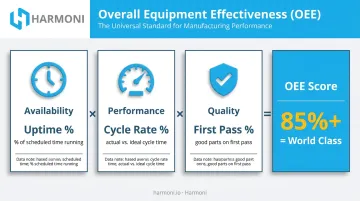
- OEE = Availability × Performance × Quality — software automates this calculation and surfaces losses as they occur, replacing manual tracking
- Many manufacturing lines operate at only 60% productivity against an 85%+ world-class benchmark — a significant pool of recoverable capacity
- Key buying criteria include machine connectivity, deployment speed, ERP/MES integration depth, and whether the platform supports root-cause analytics
- Deployment timelines range from 48 hours (sensor-based tools) to weeks (orchestration platforms) to longer for full MES suites
- Platforms covered: Harmoni, MachineMetrics, Tractian OEE, TeepTrak, Evocon — ranging from point-solution monitoring tools to full factory orchestration platforms
What Is OEE and Why Does It Matter for Manufacturing?
OEE measures three things simultaneously:
- Availability — what percentage of scheduled time is the machine actually running?
- Performance — how does actual cycle time compare to the ideal cycle time?
- Quality — what percentage of output is good parts on the first pass?
Multiply those three factors together and you get OEE. A score of 85%+ is considered world class for discrete manufacturers.
Most shops operate well below that threshold — LeanProduction puts many lines at roughly 60% productive. That gap is sometimes called the "hidden factory": recoverable capacity already sitting inside your existing equipment, not on the order sheet for new machinery.
Where OEE Losses Actually Come From
OEE.com maps production losses to six categories: equipment failure, setup and adjustments, idling and minor stops, reduced speed, process defects, and reduced yield. In most discrete manufacturing environments, Availability losses — unplanned breakdowns and changeover time — account for the largest share of lost capacity, followed by performance and quality losses.
Manual tracking systematically undercounts the losses that matter most. Minor stoppages go unlogged, operator entries are inconsistent, and spreadsheet data arrives hours after the loss occurred. By the time a supervisor sees the numbers, the shift is long over.
Common manual tracking failures include:
- Minor stoppages that operators don't bother logging
- Inconsistent reason codes that obscure the real root cause
- Batch data entry that delays visibility by hours or entire shifts
- No alert when a machine goes idle mid-run
Modern OEE software closes that gap by collecting machine signals, operator inputs, and production data automatically. Losses surface the moment they occur, so corrective action happens during the shift rather than in next week's review meeting.
Top OEE Software Solutions for Manufacturing in 2026
Platforms below were evaluated against six criteria:
- Machine connectivity breadth (modern CNC + legacy equipment)
- Deployment speed (time to live data)
- Real-time monitoring capability
- ERP/MES integration depth
- Operator data capture
- Demonstrated value in discrete manufacturing
The list spans buyer profiles from entry-level monitoring to full factory orchestration.
Harmoni
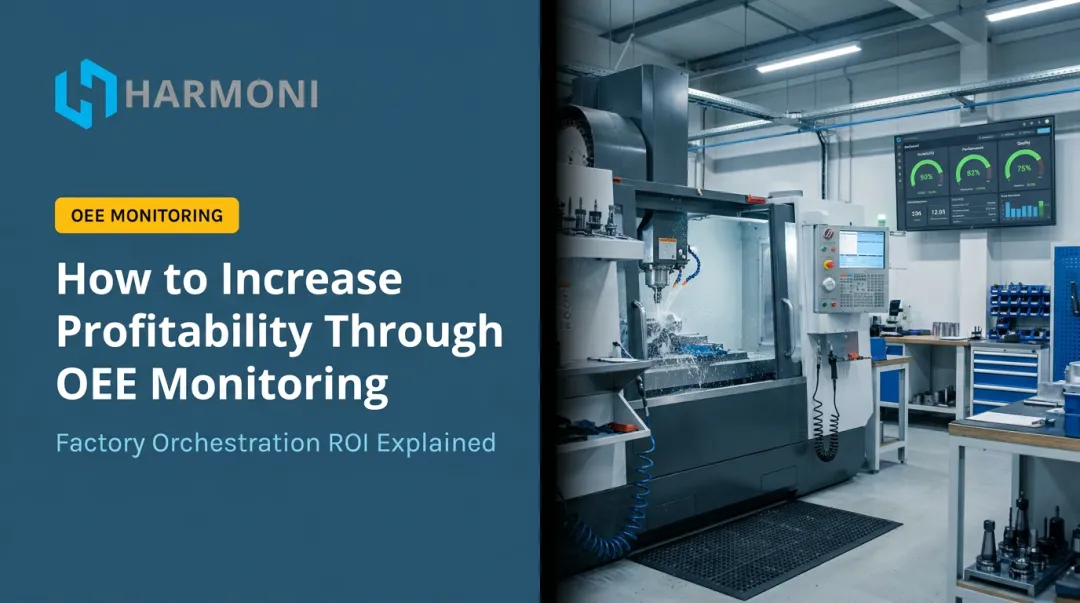
Harmoni is a factory orchestration platform built for mid-to-large discrete manufacturers in CNC machining, aerospace, defense, precision, and automotive environments. Unlike pure OEE monitoring tools, Harmoni sits between ERP systems, machines, and operators to coordinate people, engineering requirements, and production data in real time.
OEE tracking is one component of three core pillars: automation, process control, and observability. The platform measures Availability against operator labor records, Performance against ERP-defined cycle estimates, and Quality through scrap data entered at the HMI and matched to specific machine cycles.
Key differentiators:
- Long-range RFID (up to 15 feet) automatically detects operators and jobs near each workcenter , eliminating manual clock-in, job selection, and ERP transaction entry
- Centralized workcenter command center gives operators one interface for job instructions, program loading, quality checksheets, and ERP workflows
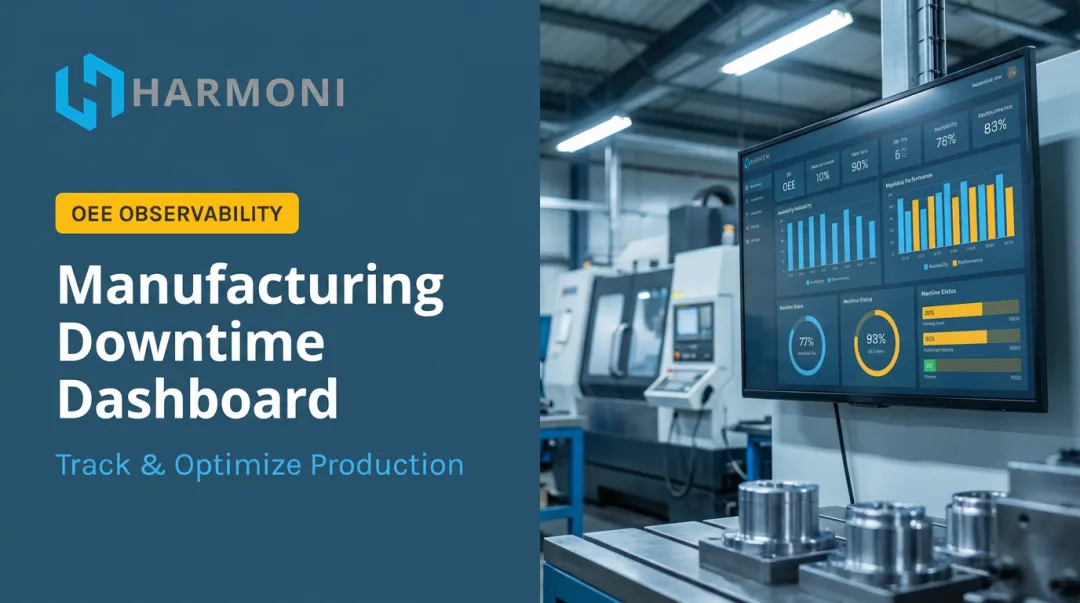
- Real-time dashboards unify machine data, ERP data, and operator activity in a single view with color-coded Visual Factory indicator lights at each terminal showing green/yellow/red OEE status
- Automated CNC program loading pushes the correct program, offsets, and settings to the machine based on the active job, eliminating wrong-program scrap
- Government Cloud deployment available for ITAR/CMMC/DoD environments
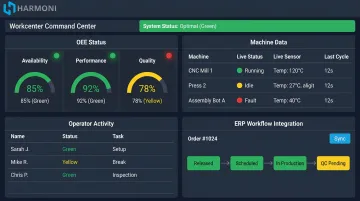
Machine compatibility: Fanuc (0i/30i/31i/32i), Haas, Mazak, Siemens/Sinumerik, Heidenhain, DMG MORI, Makino, Fadal — plus legacy equipment via analog/current sensors, RS-232/DNC, and MTConnect.
ERP integrations: Epicor, Infor, Infor Visual, ECI JobBoss/JobBoss2, ABAS, ODOO (custom integrations available for legacy systems).
| Attribute | Details |
|---|---|
| Best For | Mid-to-large CNC machining, aerospace, defense, and precision manufacturers that need to coordinate operators, machines, and ERP workflows — not just monitor uptime |
| Deployment | Deploys in weeks; WessDel case study shows installation completed in under one week with operators live on day one |
| Pricing | Contact Harmoni at sales@harmoni.io or (888) 341-4097 |
MachineMetrics
MachineMetrics is a US-based industrial IoT platform built specifically for discrete manufacturing and CNC environments. It pulls cycle-level data directly from machine PLCs and controllers, automatically categorizes downtime using machine-generated fault codes, and functions as an intelligent machine data layer.
Key differentiators:
- Native FANUC FOCAS support enables spindle-level analytics on modern CNC fleets
- Edge devices with custom software adapters standardize data across diverse equipment using MTConnect and OPC-UA
- Automated downtime categorization eliminates manual classification — faults come directly from the machine
- Strong fit for shops with modern CNC controls and dedicated IT/engineering resources
Deployment: Per MachineMetrics documentation, a 20–50 machine facility typically deploys in 4–12 weeks. Trinity Precision went live in two weeks.
| Attribute | Details |
|---|---|
| Best For | Discrete manufacturers and CNC shops with modern machine controls who prioritize deep machine-level telemetry and have IT resources to support PLC integration |
| Deployment | Weeks for modern CNC fleets; mixed or legacy environments may extend timeline |
| Pricing | Contact vendor |
Tractian OEE
Tractian OEE targets manufacturers with multiple lines or sites who want end-to-end visibility linking production losses directly to asset health and maintenance actions. Plug-and-play IoT hardware minimizes installation effort.
Key differentiators:
- Fully integrated with Tractian CMMS and condition monitoring — OEE drops automatically trigger maintenance workflows without manual escalation
- AI-generated quality plans and shift activity insights
- Cross-plant benchmarking lets leaders compare performance across sites and replicate best practices
- White-glove implementation support
| Attribute | Details |
|---|---|
| Best For | Multi-site manufacturers where linking OEE drops to corrective maintenance action is a top priority |
| Deployment | Cloud deployment; fast implementation with plug-and-play IoT hardware |
| Pricing | Contact vendor |
TeepTrak
TeepTrak is an AI-driven OEE platform founded in France with deployments across 450+ factories in 30+ countries. It goes beyond dashboard reporting through its JEMBA AI engine, trained on global cross-industry factory downtime data to identify recurring loss patterns and generate predictive maintenance alerts.
Key differentiators:
- JEMBA AI correlates downtime with operator shifts, product changeovers, and machine age — generating predictive maintenance alerts automatically
- Non-intrusive current and vibration sensors connect legacy machines without modification or PLC access
- Live OEE data on a first production line within 48 hours of sensor installation
- MoniTrak module enables cross-plant OEE benchmarking across 30+ countries
- SaaS per-line pricing with a free 48-hour proof-of-concept available
| Attribute | Details |
|---|---|
| Best For | Manufacturing groups of all sizes, particularly multi-site and global operations, that want AI-driven root cause analysis and fast time-to-value across mixed-age equipment |
| Deployment | Live OEE data in 48 hours; local support in US, France, and China |
| Pricing | SaaS per-line pricing; free 48-hour POC available |
Evocon
Evocon is a cloud-based OEE monitoring platform built for simplicity and rapid adoption. Production teams can track equipment effectiveness, capture downtime reasons, and generate automated performance reports with minimal technical onboarding , making it a practical starting point for manufacturers moving off paper logs or spreadsheets.
Key differentiators:
- Physical IIoT device installation typically completes in hours, with cloud data access within days
- Per-machine licensing (not per-user) at $189/month per machine on the Basic plan — encourages broad adoption without user seat friction
- Factory overview dashboard supports multi-machine and multi-line visibility
- Hosted on AWS with AES-256-GCM encryption; customer owns their production data
- 30-day free trial available
| Attribute | Details |
|---|---|
| Best For | Small-to-mid-sized manufacturers replacing manual logs or paper-based OEE tracking and prioritizing ease of use over deep analytics |
| Deployment | Physical setup in hours; web-based platform with 30-day free trial |
| Pricing | Per-machine licensing; Basic plan starts at $189/month per machine |
How to Choose the Right OEE Software for Your Operation
The most common mistake buyers make: selecting a platform based on dashboard aesthetics or brand recognition rather than evaluating whether it can actually connect to their machines. A visually impressive interface delivers no value if it requires months of PLC programming to extract reliable data from your existing equipment.
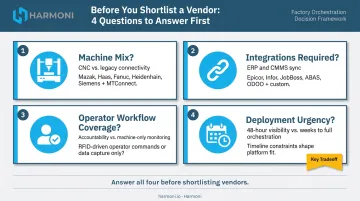
Four Questions to Answer Before You Evaluate Vendors
What's your machine mix? Modern CNC controllers support FOCAS, OPC-UA, or MTConnect natively. Older equipment may need non-intrusive current sensors, RS-232/DNC, or analog inputs. Confirm legacy support for your specific machine brands before shortlisting any vendor.
What integrations are required? Does OEE data need to sync with your ERP for job costing? Does it need to trigger CMMS work orders? Platforms differ widely in integration depth — pre-built connectors behave differently than API-only connections.
Do you need operator workflow coverage? Pure machine monitoring tells you what the equipment is doing. It does not tell you whether the right operator is at the machine, whether the right program is loaded, or whether a quality checksheet was completed. If execution consistency and labor accountability matter, that distinction changes which platform you need.
What's your deployment urgency? If you need live data this week, a sensor-first platform like TeepTrak or Evocon fits that requirement. If you're willing to invest weeks in deployment for a fully integrated solution, Harmoni or MachineMetrics delivers more operational depth.
Pricing Model Evaluation
Per-user licensing can become expensive as adoption grows — every new supervisor or manager viewing dashboards adds cost. Per-machine models (like Evocon) eliminate that friction. For Harmoni, contact the sales team directly for pricing structured around your facility size.
Beyond the license model itself, total cost of ownership over 2–3 years should include:
- Licensing fees
- Implementation services
- Connectivity hardware
- IT resources for integration maintenance
- Ongoing support costs
A lower headline price with high integration complexity can easily exceed the cost of a higher-priced platform that deploys in weeks.
Quick-Match Guide
| Priority | Best Fit |
|---|---|
| Deep CNC machine telemetry | MachineMetrics |
| AI root cause + fast deployment | TeepTrak |
| OEE tied to maintenance workflows | Tractian OEE |
| Fast entry-level monitoring, minimal IT | Evocon |
| Coordinating operators, machines, and ERP in real time | Harmoni |
Conclusion
OEE software is only as valuable as the data it collects and the actions it enables. The right platform matches your current machine inventory, integrates with your existing ERP and systems, and gives operators the visibility to catch problems during production — not after.
Before committing to a full rollout, run a focused pilot on a defined set of machines with clear baseline KPIs. Verify that the platform scales alongside your operation and handles the machine mix you actually have, not just modern equipment.
If your operation requires more than a monitoring dashboard — real-time coordination of operators, machines, and ERP workflows together — Harmoni's factory orchestration platform is built for that. It addresses the gaps that traditional OEE tools leave open: operator accountability, process control, and shop floor visibility in one unified system.
Schedule a free demo at harmoni.io/demo or contact Harmoni directly at sales@harmoni.io or (888) 341-4097.
Frequently Asked Questions
What is OEE software and how does it work in manufacturing?
OEE software automatically measures Availability, Performance, and Quality by collecting machine signals, operator inputs, and production data in real time. It replaces manual tracking and surfaces losses as they occur, so operations teams can respond during the shift rather than reviewing yesterday's numbers after the damage is done.
What is a good OEE score in manufacturing?
World-class OEE sits at 85%+ for discrete manufacturers; most production lines run closer to 60%. No single target applies to every operation — consistent improvement from your current baseline matters more than hitting an industry number.
What is the difference between OEE software and a factory orchestration platform?
OEE software primarily measures machine-level Availability, Performance, and Quality. A factory orchestration platform like Harmoni goes further — coordinating operators, ERP workflows, engineering documentation, and machine data in real time to improve how work is actually executed on the shop floor, not just reported.
How does OEE software integrate with ERP and MES systems?
Most modern OEE platforms offer API-based integrations or pre-built connectors that sync work order status, actual run times, and scrap counts back to ERP or MES. Before committing to a platform, map the specific ERP fields you need populated and test the integration in a sandbox environment to verify data accuracy.
How long does it take to see ROI from OEE software?
Replacing manual logging with automated capture delivers quick wins within weeks. Structural gains like reduced setup time and lower unplanned downtime follow over months. Harmoni's WessDel case study recorded 17 productive hours gained per employee per month, with returns exceeding 5× the platform cost.
Can OEE software connect to legacy CNC machines?
Connectivity for legacy equipment varies by platform. Some tools use non-intrusive current sensors or RS-232/DNC interfaces without needing controller APIs; others require modern PLC access. Verify legacy support for your specific machine brands before selecting a vendor, and ask whether the platform has deployed on equipment of comparable age.