Introduction
Most mid-to-large manufacturers already have an ERP system. Most have machines generating data. And yet, supervisors still walk the floor chasing verbal updates, bottlenecks surface at shift-end, and production decisions get made on information that's hours old.
The data exists. The problem is that it never reaches the people who need it, when they need it.
According to Siemens' True Cost of Downtime 2022 report, unplanned downtime costs Fortune Global 500 manufacturers approximately $1.5 trillion annually — about 11% of total turnover. Meanwhile, the Manufacturing Leadership Council's 2024 survey found 70% of manufacturers still collect shop floor data manually.
The right platform closes that gap by surfacing live production status, not just historical records.
This guide evaluates the top MES and shop floor visibility systems for mid-to-large manufacturers in CNC machining, aerospace, defense, and precision manufacturing — including traditional MES platforms and Harmoni's factory orchestration category — and provides a structured evaluation framework covering key capabilities, deployment considerations, and fit criteria for each platform type.
Key Takeaways
- An MES connects ERP planning to actual shop floor execution — capturing real-time data on machines, operators, materials, and job progress
- Real-time visibility means catching problems while production is running — not in tomorrow's report
- The best system integrates with your ERP and puts actionable data in front of supervisors while it still matters
- Traditional MES platforms handle structured environments well; Harmoni's factory orchestration platform adds a coordination layer that ties ERP, machines, and operators together
- Key selection criteria: ERP integration depth, machine connectivity, how fast it deploys, whether operators can actually use it, and live dashboard capability
Why Real-Time Shop Floor Visibility Remains a Manufacturing Challenge
ERP systems are built for planning and financials. They tell you what should happen, not what is happening. That structural gap between the front office and the shop floor is real, and paper travelers, spreadsheets, and verbal updates don't close it.
The damage from delayed data isn't subtle. By the time a quality issue, bottleneck, or unplanned downtime event shows up in an ERP report, the consequences have already compounded: lost material, missed schedules, incorrect labor charges, and supervisors chasing problems that finished hours ago.
The ISA-95 standard (IEC 62264) formally addresses this by defining Manufacturing Operations Management as the layer between enterprise planning and production control. As MESA's 2024 data-mapping analysis describes it, an MES collects and aggregates shop floor data and sends structured messages upward to the ERP.
That handoff only works when the MES is actually capturing live data from the floor in the first place — which is where most implementations fall short.
Most manufacturers have the planning layer (ERP) and the production layer (machines). What's missing is an active coordination layer between them — one that captures what's actually happening on the floor and makes that data available in real time.
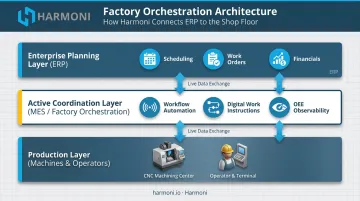
MES and factory orchestration platforms were built specifically to close this gap — and the platforms covered below each take a different approach to doing it.
Top 5 Systems for Real-Time Shop Floor Visibility
The five platforms below were selected for their ability to deliver actionable, real-time shop floor data — not just dashboards, but decision-enabling visibility. They span enterprise MES, modular IoT platforms, no-code digitization tools, and a factory orchestration layer. Use the summaries and comparison tables to match each option to your manufacturing environment.
Siemens Opcenter
Siemens Opcenter is a unified Manufacturing Operations Management (MOM) portfolio designed for mid-to-large discrete, electronics, and automotive manufacturers that need tight coordination between production execution, scheduling, quality, and PLM data.
Its Opcenter Intelligence module converts live production data into dashboards that show planned vs. actual performance in real time, enabling supervisors to catch deviations early. Opcenter Execution Discrete targets job shops and complex assembly with BOM/BOP management, production tracking, and visibility. The deep ERP and PLM integration creates a closed loop between engineering design and shop floor execution.
The trade-off: Opcenter's enterprise-grade capability comes with enterprise-grade complexity. Expect significant IT resources, structured training, and longer implementation timelines.
| Category | Details |
|---|---|
| Best Fit | Mid-to-large discrete, electronics, and automotive manufacturers with existing Siemens infrastructure or complex ERP/PLM integration needs |
| Real-Time Visibility Strength | Live planned-vs-actual dashboards, genealogy tracking, and real-time analytics via Opcenter Intelligence |
| Deployment Consideration | Multi-module enterprise deployment; longer implementation timelines and higher IT resource requirements |
Rockwell Automation FactoryTalk ProductionCentre
FactoryTalk ProductionCentre is a multi-industry MES built for highly automated plants — particularly automotive, life sciences, and electronics — where machine-level data acquisition and real-time quality enforcement are central to operations.
Key capabilities include:
- Pulls live data from machines, PLCs, and automation equipment for immediate throughput and downtime visibility
- Triggers non-conformance alerts in real time with built-in CAPA management workflows
- Supports regulated-environment compliance through native audit trail functionality
The barrier: configuration complexity and cost can be significant for teams without dedicated MES or Rockwell expertise — this is an enterprise-scale investment, not a quick-start deployment.
| Category | Details |
|---|---|
| Best Fit | Highly automated manufacturers in automotive, life sciences, and electronics with strong automation infrastructure |
| Real-Time Visibility Strength | Live machine data acquisition; integrated production monitoring, quality alerts, and non-conformance tracking |
| Deployment Consideration | Enterprise-scale investment; modular rollout is possible but complex |
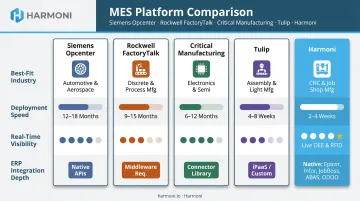
Critical Manufacturing MES
Critical Manufacturing MES is a modular, IoT-enabled platform built for high-tech electronics and complex discrete manufacturing environments that need granular, real-time tracking across multiple product lines and production steps.
Core strengths include:
- Deploy only the visibility modules needed today, then expand over time
- Automates equipment and sensor data collection via the Connect IoT module — no manual entry
- Supports cloud, on-premise, or hybrid deployment with strong genealogy tracking
The catch: full IoT integration and customization require dedicated MES and IT expertise, and costs scale as modules are added.
| Category | Details |
|---|---|
| Best Fit | Medium-to-large high-tech electronics and discrete manufacturers running complex, multi-step production with IoT-connected equipment |
| Real-Time Visibility Strength | Automated IoT data collection; real-time WIP tracking, equipment status, and production metrics across multiple lines |
| Deployment Consideration | Modular deployment reduces initial risk; customization and full IoT integration require longer setup timelines |
Tulip Frontline Operations
Tulip is a no-code/low-code platform that lets manufacturers digitize frontline operations and build their own shop floor apps — work instruction delivery, quality checks, operator data capture, and production dashboards — without traditional MES development resources.
Tulip's primary strength is speed and adoption. Teams can build and deploy data-capture apps quickly, giving supervisors near-real-time views into operator activity at each station. Tulip cites an industrial equipment manufacturer deploying MES in three months, and offers structured onboarding packages starting at three weeks for targeted rollouts.
Where it falls short: Tulip is best suited for small-to-mid manufacturers or targeted digitization projects. It lacks the depth of enterprise MES for regulated industries or highly automated environments requiring machine-level data integration.
| Category | Details |
|---|---|
| Best Fit | Small-to-mid manufacturers, assembly-focused operations, and teams seeking rapid digitization of specific workcells without heavy IT investment |
| Real-Time Visibility Strength | Real-time operator data capture from tablets and workstations; live production dashboards from configurable no-code apps |
| Deployment Consideration | Fast deployment with minimal IT overhead; limited depth in machine-level analytics and enterprise ERP integration |
Harmoni (Factory Orchestration Platform)
Harmoni is a factory orchestration platform that sits between ERP systems, machines, and operators — coordinating people, processes, and engineering requirements in real time. Unlike traditional MES platforms, it functions as an orchestration layer rather than a system of record, which changes how it deploys and what it costs.
Key differentiators:
- Native ERP integration with Epicor, Infor, Infor Visual, JobBoss/JobBoss2, ABAS, and ODOO — automatically pushing labor records, machine production time, scrap, and quality data into the ERP without manual entry
- Direct machine connectivity to Fanuc, Haas, Mazak, Heidenhain, Siemens, DMG MORI, Makino, and Fadal controllers — including legacy equipment that doesn't require replacement
- Long-range RFID technology that automatically detects operators and active jobs at each workcenter from up to 15 feet away, eliminating manual clock-ins entirely
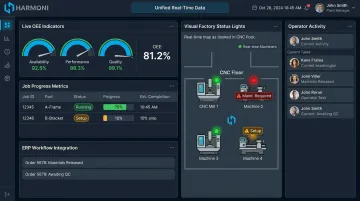
- Real-time dashboards combining machine data, ERP workflows, and operator activity in one unified view
- Visual Factory indicator lights that communicate live OEE conditions (green/yellow/red) from across the shop floor — not just whether a spindle is spinning
Harmoni's performance component of OEE is calculated against the expected cycle time from your ERP job definition, making the metric directly tied to how production is performing against your actual cost model — not an abstract benchmark.
Deployment reality: WessDel, an aerospace and defense machine shop in San Jose, was live on Harmoni in under a week — recovering an average of 17 productive hours per employee per month and delivering returns exceeding 5x the ongoing platform cost.
For manufacturers handling defense programs, Harmoni also offers a Government Cloud deployment at portal.us.harmoni.io supporting CMMC, DFARS, and CUI-handling requirements with machine-level MFA and full audit logs.
| Category | Details |
|---|---|
| Best Fit | Mid-to-large manufacturers in CNC machining, aerospace, defense, and precision manufacturing needing real-time visibility across operators, machines, and ERP data without a full MES replacement |
| Real-Time Visibility Strength | Unified dashboards combining machine data, ERP workflows, and operator activity; RFID-based automatic job and employee detection; OEE Visual Factory alerts |
| Deployment Consideration | Deploys in weeks; acts as an orchestration layer that improves how existing MES and ERP systems operate — works alongside or independently of a traditional MES |
Key Features That Define Effective Shop Floor Visibility
Not all visibility systems are equal. These five capabilities separate platforms that genuinely deliver real-time intelligence from those that just report on what already happened.
ERP and Machine Integration Depth
Real-time visibility is only as good as its data sources. A platform must pull live data from both the ERP (work orders, job status, schedules) and from machines (cycle times, downtime events, spindle utilization) simultaneously.
Any system that requires manual data entry at any point in this chain introduces delays that undermine real-time visibility — which defeats the purpose entirely.
Operator Activity Tracking Without Adding Friction
Knowing what machines are doing is half the picture. Supervisors also need to see what operators are doing, which jobs they're on, and whether they're following the correct sequence.
RFID-based automatic detection — like Harmoni's approach — captures this data passively as operators move through the shop. Systems relying on manual clock-ins introduce accuracy problems and create the exact friction that causes operators to skip steps.
Real-Time Dashboards and Alerting
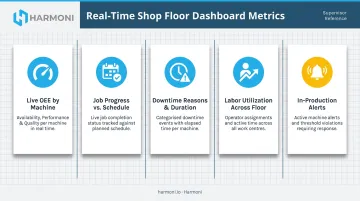
The right system gives supervisors:
- Live OEE by machine
- Job progress vs. schedule
- Downtime reasons and duration
- Labor utilization across the floor
- Alerts when a job falls behind or a machine goes down — while production is still running
Paperless Work Instructions and Process Control
Visibility alone doesn't prevent errors. The system should deliver digital work instructions, enforce process steps in sequence, and capture quality data at the point of execution.
This closes the loop between what operators are told to do and what they actually do — critical in aerospace, defense, and precision manufacturing where revision errors create expensive scrap.
Deployment Speed and Operator Usability
A system that takes 18 months to deploy delivers no visibility benefit during that window. Evaluate candidate systems on:
- How quickly they can be running on the floor
- Whether the interface requires minimal learning curve
- Whether operators will actually use it correctly from day one
Adoption rate directly determines data quality. A platform operators skip — or use inconsistently — produces incomplete data, which means the visibility you're buying never fully materializes.
How We Chose the Best MES for Real-Time Shop Floor Visibility
These systems were assessed on their ability to deliver genuinely real-time production data — not delayed reports — with specific focus on mid-to-large manufacturers in high-mix, precision-driven environments.
One common buyer mistake: selecting a system based on feature count or brand recognition without first validating ERP and machine controller compatibility. A platform with deep functionality but a broken ERP integration will underperform a narrower tool that connects cleanly with your actual environment.
Evaluation criteria applied:
- Real-time data capture from machines and operators
- ERP integration breadth and data depth
- Deployment timeline (weeks vs. months)
- Operator usability and adoption likelihood
- Dashboard and alerting capability during production
- Traceability support for aerospace and defense requirements
- Total cost of ownership, including implementation and ongoing support
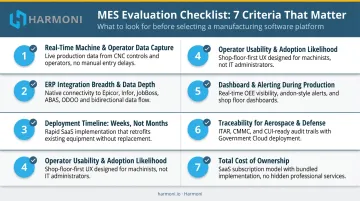
The key differentiator was unified context. Systems that combine machine data, operator activity, and ERP context in a single view ranked above those capturing only one or two. When those streams live in separate reports, a supervisor is doing reconciliation work that the software should handle.
Conclusion
Manufacturers who catch production problems while a job is still running make better decisions than those who discover them during the post-shift review. Whatever platform you choose — traditional MES or a factory orchestration system like Harmoni — it needs to surface machine, operator, and ERP data simultaneously so supervisors can act before output is lost.
Three criteria tend to separate platforms that deliver lasting value from those that look good in a demo:
- Can it scale with your production complexity without requiring a full re-implementation?
- Does it natively support your specific ERP version, not just a generic API handshake?
- How quickly will it deliver measurable improvements — weeks, not a multi-year roadmap?
For manufacturers who want real-time shop floor visibility without a multi-year implementation, Harmoni's factory orchestration platform deploys in weeks and connects machines, operators, and ERP systems into a single real-time dashboard. Contact the team at sales@harmoni.io or call (888) 341-4097 to see how it works in a CNC, aerospace, or precision manufacturing environment.
Frequently Asked Questions
What is the difference between an MES and a factory orchestration platform?
An MES manages and records production execution — tracking what happened and when. A factory orchestration platform like Harmoni sits between ERP systems, machines, and operators to actively coordinate workflows and surface real-time data as events occur, directing and observing activity rather than logging it afterward.
What features should I look for in an MES for real-time shop floor visibility?
Prioritize live ERP and machine data integration, automatic operator activity tracking, real-time dashboards with in-production alerts, digital work instructions, and automated downtime capture. Any system that requires manual data entry at a step in this chain introduces delays that undermine genuine real-time visibility.
How long does MES implementation typically take for mid-sized manufacturers?
Traditional enterprise MES implementations typically take 6–18 months depending on scope and integration complexity. Modern orchestration platforms designed for mid-sized manufacturers — like Harmoni — can deploy in weeks through phased approaches that target specific workcells first and build out from there.
Can a shop floor visibility system work with my existing ERP?
Most modern MES and orchestration platforms integrate with common ERP systems including Epicor, Infor, JobBoss, ODOO, and others. Verify that connector availability covers your specific ERP version, and confirm whether the integration is native or requires custom development, as that choice directly affects deployment timeline and ongoing maintenance costs.
What is OEE and why does it matter for shop floor visibility?
Overall Equipment Effectiveness (OEE) is a combined metric of machine Availability, Performance, and Quality. Real-time OEE tracking requires a shop floor system that captures machine downtime, cycle time, and production counts automatically, helping manufacturers identify where capacity is being lost before it affects delivery schedules.
How is real-time shop floor visibility different from standard ERP production reporting?
ERP production reports reflect data entered after the fact — often hours later. Real-time shop floor visibility systems capture machine and operator data as events occur, enabling supervisors to respond to delays, quality issues, or downtime within minutes rather than discovering them in the next morning's report.