Introduction: AI Agents Are Changing What Manufacturers Can See — and When They See It
Most manufacturers still find out about production problems too late. A machine ran bad parts for two hours before anyone noticed. An operator skipped a setup step. A job fell behind schedule — and nobody knew until the shift review. By then, the scrap has piled up and the damage is done.
That lag isn't just frustrating. It's expensive. NIST estimates $119.1 billion in preventable losses annually for discrete manufacturers — costs driven largely by maintenance failures, quality escapes, and undetected downtime that reactive monitoring simply can't catch in time.
AI agents are changing that equation. These are software systems that continuously ingest shop floor data, detect anomalies, and push relevant information to the right person without waiting for a human to run a report. What follows covers where this technology is delivering real results, what honest deployment looks like, and how to tell whether it's working.
Key Takeaways:
- Shifts monitoring from scheduled reports to continuous, real-time anomaly detection
- OEE tracking, predictive maintenance, and quality inspection are where AI monitoring delivers the most proven results
- Most manufacturing AI agents today operate in advisory mode, which is the right starting point
- Meaningful monitoring requires machine data, operator context, and ERP records working together
- Focused 8–12 week pilots on a single asset or workcenter are the lowest-risk entry point
What AI Agents Actually Do for Shop Floor Monitoring
A dashboard shows you what happened. An AI agent watches for what's about to go wrong.
That distinction matters more than it sounds. Traditional dashboards display historical data when you ask for it. AI agents continuously ingest live data from machines, operators, and production systems — and proactively surface anomalies before a human thinks to look.
From Data Collection to Active Detection
In a shop floor context, AI agents pull from multiple sources simultaneously:
- Machine data — spindle status, cycle times, feed rates, alarms, and current draw from CNC controllers and PLCs
- Operator activity — who is at which machine, what job is running, whether prescribed workflows are being followed
- ERP/MES records — planned cycle times, job status, quality requirements, and labor transactions
The agent's job is to correlate signals across these streams and flag when something doesn't fit the expected pattern. A machine cycle that's drifted 15% slower than the ERP-quoted time. A machine sitting idle 20 minutes past what the job sequence requires. A combination of vibration and temperature readings that historically precede a spindle failure.
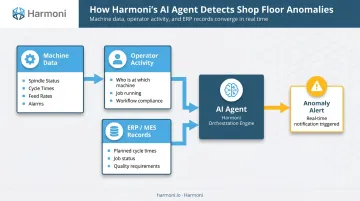
But detecting the anomaly is only half the problem. Understanding why it happened requires knowing who was running the machine and what job was active when the deviation occurred.
Why Operator Context Completes the Picture
A spindle running at 60% capacity tells you there's a problem. It doesn't tell you whether the operator ran the wrong program, skipped a setup step, or is waiting on material. Machine data without operator context is an incomplete signal.
When AI agents can also track who is operating which machine and what job is active, the monitoring picture becomes operationally complete. Platforms like Harmoni use long-range RFID technology to automatically associate operators and jobs with machine activity in real time — so anomalies can be understood in full context, not just flagged as raw sensor events.
Alert Routing: Signal vs. Noise
The last piece is routing. An AI agent that sends every alert to everyone creates noise, not value. Effective monitoring requires escalation logic that directs the right information to the right role:
- Machine fault → maintenance technician
- Quality deviation → quality engineer
- OEE drop → floor supervisor
- Job behind schedule → production scheduler
Defining that logic upfront — before alerts start firing — determines whether your monitoring system drives action or gets ignored.
Key Shop Floor Monitoring Use Cases Where AI Agents Are Delivering Results
Real-Time Machine Status and OEE Tracking
Automated machine monitoring eliminates the biggest flaw in traditional OEE reporting: the data is only as good as what operators manually entered.
AI agents classify machine states — running, idle, setup, fault — automatically, without requiring operators to enter reason codes. SME reports that manufacturers using real-time automatic data collection achieved an average 9% downtime reduction before applying additional efficiency improvements. Individual case results show larger gains: Mitotec saved $1.4 million in 11 months (including $656K from unplanned downtime reduction) after deploying sensor-based OEE monitoring, and Global Precision Parts improved machine utilization by 10% while saving 45 minutes per day of manual data entry.
OEE accuracy matters because wrong data drives wrong decisions. If reported utilization is artificially high because idle time goes uncaptured, capital investment goes to the wrong machines.
Predictive Maintenance Alerts
Predictive maintenance is the most mature and widely deployed AI agent use case in manufacturing today.
Agents analyze time-series sensor data — vibration signatures, temperature trends, current draw patterns, and motor load anomalies — and compare them against historical failure signatures. When the pattern suggests elevated risk, the agent flags it before the failure occurs.
The agentic component goes beyond the flag. A well-designed predictive maintenance agent will:
- Recommend an optimal maintenance window based on production schedule
- Check spare parts availability in the storeroom system
- Draft a work order for human review and approval
- Notify the assigned maintenance technician automatically
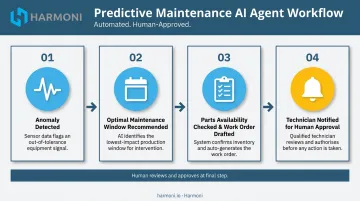
A human still approves and schedules the work — but the agent has completed the diagnostic and preparation steps automatically.
NIST research associates predictive and advanced maintenance with 15% less downtime and 87% lower defect rates in discrete manufacturing. Deloitte benchmarks predictive maintenance at reducing facility downtime by 5–15% and maintenance costs by 5–10%.
Visual Quality Inspection and Defect Detection
AI-powered computer vision systems can inspect 100% of parts or assemblies in real time — replacing statistical sampling with complete inspection at production speed. These systems detect surface defects, dimensional anomalies, and assembly errors that manual inspectors would catch intermittently.
More sophisticated deployments correlate detected defects back to upstream process parameters — specific machine, tool wear state, material lot, and operator — enabling root cause identification rather than simple defect recording. Quality teams can act on that causal data to prevent the same defect from reappearing in the next run.
Shift Performance and Labor Visibility
AI agents can track job progress against planned cycle times throughout a shift — surfacing underperformance or bottlenecks while there's still time to respond.
The value here is supervisory, not surveillance. If a job is running 25% slower than the ERP-quoted time at 10 AM, a supervisor can intervene, diagnose the problem, and potentially recover the shift. Discovering the same gap at the 3 PM review doesn't help anyone.
That kind of timely intervention depends on having operator context alongside machine data. Harmoni's platform connects shift visibility to RFID-based operator identification, so supervisors see who is running what — not just which machines are underperforming.
Production Bottleneck and Throughput Monitoring
AI agents monitoring WIP queue depths and inter-operation wait times can identify constraint workcenters before delays propagate across the floor.
When jobs are stacking up at a specific workcenter, that's visible in real time — giving schedulers the option to redirect capacity, adjust sequencing, or escalate before a late job becomes a missed delivery.
Advisory vs. Autonomous: Where Manufacturing AI Agents Realistically Stand Today
Two Modes, Very Different Risk Profiles
Advisory agents surface data, flag anomalies, and generate recommendations. A human reviews and decides whether to act.
Autonomous agents take direct action in a live system — changing a setpoint, triggering a workflow, updating an ERP record — without human approval.
In manufacturing, the vast majority of deployed AI agents operate in advisory mode. This isn't a technology limitation. It's the right call.
Manufacturing decisions carry physical consequences: scrap, safety risk, regulatory exposure, downtime. An agent that autonomously adjusts a machine parameter based on a flawed inference doesn't just cause a software error — it can cause a $50,000 scrapped part or an unsafe condition.
NIST describes AI agents as systems that can "reason, plan, and act independently", but also identifies reliability gaps and ROI uncertainty as real barriers to autonomous deployment in production environments.
What Must Be True Before Autonomy Expands
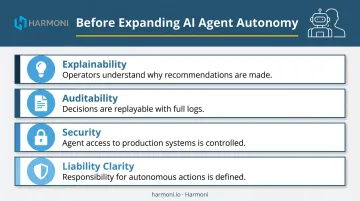
Four conditions need to be met before extending agent autonomy in a manufacturing environment:
- Explainability — operators and engineers must understand why the agent made a recommendation, not just what it recommended
- Auditability — decisions must be replayable with full logs of what the agent saw and what it concluded
- Security — agent access to production systems must be controlled and monitored
- Liability clarity — it must be clear who is responsible when an autonomous action causes a problem
Model Drift: Why AI Agents Need Ongoing Management
AI agents don't stay accurate indefinitely. Model drift occurs when the real-world patterns the model was trained on shift over time — as machines wear, materials change, or processes evolve. An agent trained on data from a well-maintained spindle may generate false positives once that spindle ages, or miss genuine failure signals from a new machine configuration.
AI agents in manufacturing require active management:
- Regular performance reviews to catch accuracy degradation early
- Version control so teams can track what changed and when
- Rollback capability if a model update introduces new errors
That management burden directly shapes how quickly — and how safely — autonomy can expand.
The Path Toward Greater Autonomy
Safe expansion of autonomy typically requires digital twin infrastructure — the ability to simulate a proposed action in a virtual environment before executing it on the real floor. That capability is still rare in production environments. The practical path forward is to:
- Establish strong data foundations now
- Validate agent recommendations consistently over 6–12 months
- Build simulation environments for testing before extending live authority
What It Takes to Deploy AI Agents for Shop Floor Monitoring
Data and Connectivity Readiness
AI agents are only as good as the data they see. Shop floor monitoring agents need reliable access to three streams:
- Machine data via MTConnect, OPC-UA, direct PLC connections, or IoT gateways
- Operator and labor activity tied to specific machines and jobs
- ERP/MES production records — planned times, job assignments, quality requirements
An agent that sees machine data but not job context will flag anomalies it can't explain. Without ERP status, that same agent can't distinguish a genuine process problem from an intentionally reduced-speed first article.
Harmoni's factory orchestration platform sits between ERP systems, machines, and operators, integrating with major CNC controllers (Fanuc, Siemens, Haas, Mazak, DMG MORI, Heidenhain, Makino, Fadal) and ERP systems (Epicor, Infor, Infor Visual, JobBoss, ABAS, Odoo) to provide the unified data foundation that AI monitoring agents require.
Harmoni deploys in weeks without replacing existing equipment. Even legacy machines are supported through adapter layers, with one customer describing the system as "seamlessly working with Epicor out of the box."
Start Bounded, Prove Value, Then Scale
The recommended implementation sequence:
- Select one critical asset, workcenter, or process with a known, measurable problem — chronic unplanned downtime, poor OEE visibility, recurring quality escapes
- Establish a baseline metric before deployment (current downtime hours, OEE percentage, scrap rate)
- Run a focused pilot for 8–12 weeks with defined success criteria
- Use those results to build the business case for broader deployment
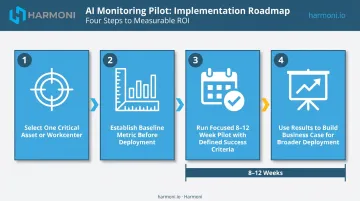
This approach reduces implementation risk and builds operator trust simultaneously. A pilot that delivers a measurable result earns credibility with the floor, and that credibility is what drives adoption past the pilot phase.
Governance, Permissions, and Change Management
Technical deployment is the easier half. Governance decisions need to be made upfront:
- Who can view monitoring alerts vs. who can act on them
- What approval workflows are required before agent recommendations are executed
- How agent performance is reviewed over time
- Who owns rollback decisions when model drift is detected
Operator buy-in matters just as much. Frame AI monitoring as a tool that catches problems operators can't see, not as a surveillance mechanism. Operators who see the system catching problems they'd otherwise miss at shift-end tend to become its strongest advocates.
Tracking ROI: Metrics That Prove AI Agent Monitoring Value
Operational Performance Metrics
These are the before/after comparisons from a 90-day pilot that justify broader investment:
- OEE improvement — measured as overall percentage and broken down by Availability, Performance, and Quality components
- Unplanned downtime reduction — mean time between failures (MTBF) and mean time to repair (MTTR) trends
- First-pass yield improvement — percentage of parts passing inspection without rework
- Scrap rate reduction — direct cost avoidance from defects caught earlier in the process
A Deloitte survey of 600 executives reported 10–20% production output improvement and 7–20% asset efficiency improvement following smart manufacturing implementations — ranges that align with case-study evidence from individual shop deployments.
Visibility and Response Time Metrics
These metrics capture monitoring-specific value that OEE numbers alone miss:
- Mean time to detect (MTTD) — how long between a problem occurring and someone knowing about it
- Mean time to resolve (MTTR) — how long from detection to resolution
- Percentage of problems identified during the shift vs. post-shift — this single metric often reveals the real cost of reactive monitoring
- Reduction in end-of-shift surprises — a qualitative measure that supervisors track intuitively
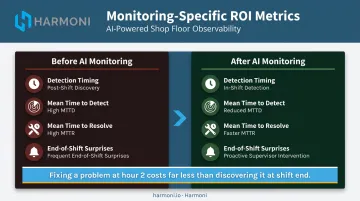
The shift from post-shift discovery to in-shift detection is where AI agent monitoring earns most of its operational value. Fixing a problem at hour two costs far less than discovering it at shift end.
Labor and Cost Efficiency Metrics
Faster detection isn't the only place AI monitoring saves money. Quantify the labor freed from manual data collection:
- Hours per week previously spent on manual OEE reporting, status checks, and data entry
- Cost of that labor at fully-loaded rates
- Data accuracy improvement (ERP records that now reflect actual vs. estimated job times)
Accurate job costing compounds these gains. When actual machine time, operator time, and downtime per job flow automatically into the ERP — which Harmoni's platform handles via direct ERP integration — downstream estimating and quoting improve, and profitability analysis becomes reliable rather than built on incomplete data.
Frequently Asked Questions
How can AI help in shop floor operations?
AI agents continuously monitor machines, operators, and production data to surface anomalies, flag quality deviations, predict equipment failures, and deliver targeted alerts to the right people in real time. The core shift is from reactive operations management (finding problems after they've caused damage) to proactive intervention while there's still time to act.
How do you monitor an AI agent itself?
Track key performance metrics over time: recommendation accuracy, alert false-positive rates, and signs of model drift. Establish regular review cadences, maintain version control and audit trails, and build in rollback capability. AI agents in production environments must be actively managed like any other critical system, not deployed and forgotten.
What is the difference between advisory and autonomous AI agents in manufacturing?
Advisory agents surface insights and recommendations for humans to review and act on. Autonomous agents take direct action in live systems without human approval. Most manufacturing AI agents today operate in advisory mode: errors carry real physical consequences (scrap, safety risk, downtime) that make human-in-the-loop oversight the appropriate starting point.
What data do AI agents need to monitor a shop floor effectively?
Three core streams: machine data (from sensors, PLCs, and CNC controllers), operator and labor activity data, and production/job data from ERP or MES systems. Combining all three gives agents the operational context to monitor meaningfully, not just flag raw sensor anomalies stripped of job or operator context.
What are the biggest challenges in deploying AI agents on the shop floor?
Data connectivity across legacy equipment, ensuring explainability so operators trust the recommendations, managing model drift over time, and defining clear governance for who acts on agent outputs. Governance and change management often matter as much as the technology itself. A technically sound agent that operators won't act on delivers little value.
How long does it take to implement AI agents for shop floor monitoring?
Focused pilots targeting a single asset or use case can deliver measurable results in 8–12 weeks, especially when built on a platform that already integrates with your machines and ERP. Harmoni customers have gone from initial deployment to full shop-wide rollout within a few months, with one manufacturer completing the full installation in under a week.