Introduction
Most manufacturers don't lose capacity to a single catastrophic failure. They lose it gradually — an operator spends 20 minutes hunting down a setup sheet, a machine sits idle waiting for the next job, a quality issue discovered at final inspection traces back to a step that three different shifts handled three different ways.
These accumulated inefficiencies are harder to see than a broken machine, but their cost is just as real. ABB's 2023 survey of 3,215 plant-maintenance decision-makers found unplanned downtime costs industrial businesses roughly $125,000 per hour — and over two-thirds experience it at least monthly.
Getting more out of your existing operations means more than rearranging workstations. It requires coordinating people, machines, systems, and engineering data into a coherent execution layer where what's planned actually happens on the floor.
This article covers 10 actionable strategies across four domains: process control and workflow standardization, automation and technology integration, real-time visibility, and organizational culture.
Key Takeaways
- Fixing workflows alone isn't enough — closing the coordination gap between people, machines, and systems drives real gains
- Execution gaps (the space between what ERP plans and what operators do) are where the biggest efficiency losses hide
- Real-time bottleneck identification consistently outperforms post-production analysis
- Sustainable improvement depends on management buy-in, cross-functional alignment, and connected technology
- Every strategy below applies regardless of facility size or existing technology stack
Why Streamlining Manufacturing Operations Matters
Inefficiency compounds. A delayed operation doesn't just affect one job — it cascades into missed delivery windows, idle downstream equipment, and overtime costs that weren't budgeted.
The business case for addressing this is clear. Deloitte's 2025 Smart Manufacturing survey of 600 executives found 92% believe smart manufacturing will be the primary driver of competitiveness over the next three years. Manufacturers that have already implemented smart initiatives report:
- 10–20% improvement in production output
- 7–20% gain in employee productivity
- 10–15% increase in unlocked capacity
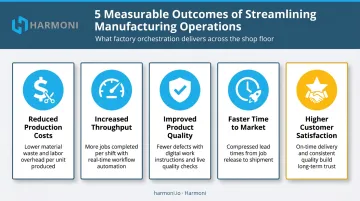
Streamlining delivers five measurable outcomes:
- Reduced production costs through less waste and rework
- Increased throughput by eliminating bottlenecks and idle time
- Improved product quality through consistent process execution
- Faster time to market with shorter, more predictable lead times
- Higher customer satisfaction from reliable on-time delivery
For precision-driven industries — aerospace, defense, CNC machining, medical device manufacturing — the stakes are higher still. Tolerances leave no room for process variation, and traceability requirements make documentation non-negotiable. The ten strategies below address both.
Strategies 1–3: Process Control and Workflow Standardization
Strategy 1: Standardize and Document Operator Workflows
When different operators follow different steps for the same job, the result is unpredictable scrap, rework, and quality escapes. The ASQ defines internal failure costs (scrap and rework) as a direct component of the cost of quality, and inconsistent execution is one of their most common drivers.
The solution is documented standard operating procedures combined with digital work instructions delivered at the workcenter. Paper travelers and memory-based knowledge don't scale across shifts. Digital instructions presented at the machine ensure every operator follows the same process every time — regardless of experience level or shift.
In regulated industries, this goes beyond efficiency. The FDA's Quality System Inspection Technique requires medical device manufacturers to define, document, and implement quality-system procedures — and deviation from documented process is a compliance failure, not just a quality risk. The same obligation applies in aerospace (AS9100) and defense (ITAR/CMMC) environments:
- FDA / ISO 13485 — documented procedures are a regulatory requirement for medical device manufacturers
- AS9100 — aerospace quality management demands traceable, controlled process documentation
- ITAR / CMMC — defense manufacturers must demonstrate procedural control as part of cybersecurity and access compliance
Platforms like Harmoni deliver digital work instructions, setup sheets, and quality checksheets directly at the CNC machine terminal. When an operator clocks into a job via RFID, the system automatically surfaces the correct instructions for that specific part and revision — eliminating the risk of working from outdated documentation.
Strategy 2: Identify and Eliminate Production Bottlenecks in Real Time
A single delayed operation rarely stays isolated. As NIST MEP notes, delayed materials and process stoppages can disrupt schedules, create work stoppages, and cause missed shipments. The cascade effect of a single bottleneck — idle downstream machines, expedited labor, compressed delivery windows — typically far outweighs the original delay.
The critical distinction is when you identify the problem. Traditional manual reporting creates a lag measured in hours or shifts. By the time a supervisor sees the issue on a report, the damage is done.
Real-time monitoring of key metrics changes the response window:
- Machine utilization — is this asset running when it should be?
- Cycle time vs. standard — is this operation taking longer than planned?
- Job progress vs. schedule — is this work order on track for its delivery date?
- OEE (Availability, Performance, Quality) — where is production loss actually occurring?
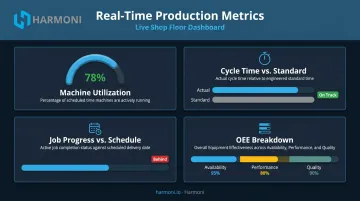
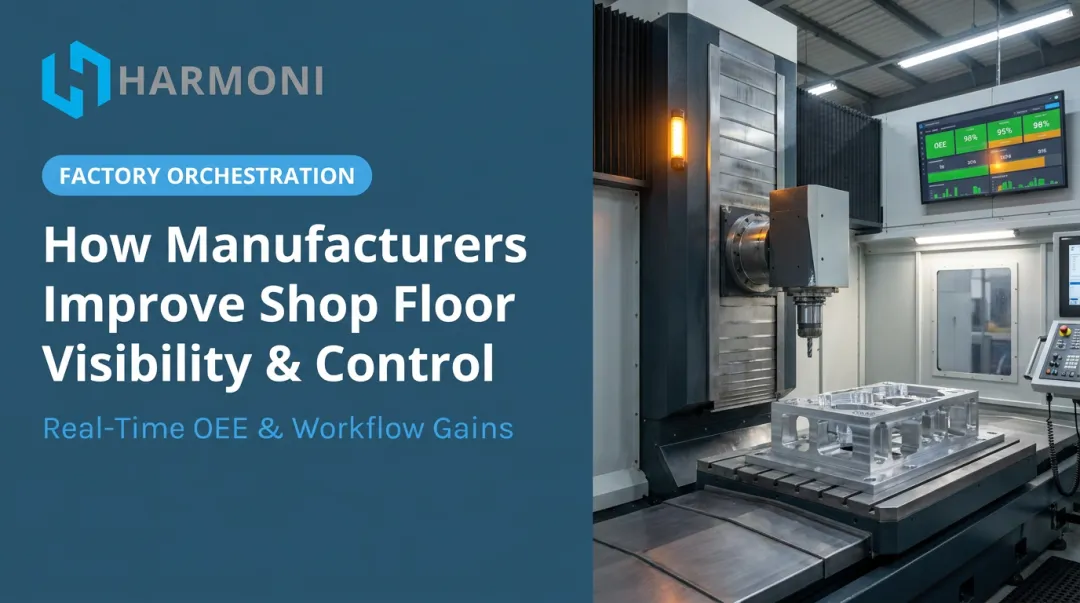
Harmoni's real-time dashboards surface these metrics live, with manager exception alerts delivered when performance deviates from expected thresholds — enabling intervention while production can still be recovered.
Strategy 3: Optimize Workspace Organization and Flow
NIST MEP's lean manufacturing resources identify 5S — Sort, Set in order, Shine, Standardize, Sustain — as a foundational methodology for improving workspace organization. The NIST MEP National Network has delivered over 80,000 lean manufacturing projects using this framework.
Physical clutter forces operators to search for tools and materials. Poor machine layout creates unnecessary travel between workstations. Paper-based processes require manual handling, filing, and retrieval that adds nothing to the part.
Wasted motion is one of lean manufacturing's eight classic wastes. It rarely appears as one obvious failure — instead it accumulates across dozens of small actions per shift, invisible until someone measures it.
Workspace optimization today means:
- Eliminating unnecessary materials and equipment from workcenters
- Arranging tools and materials for minimum travel
- Replacing paper-based processes with digital workflows at the machine
- Standardizing visual management so floor status is visible at a glance
Strategies 4–6: Automation and Technology Integration
Strategy 4: Automate Repetitive Tasks and Non-Productive Manual Steps
Automation in manufacturing extends well beyond robotic arms. Deloitte found that 46% of manufacturers prioritize process automation as a top investment over the next two years — ahead of physical automation at 37%.
The reason is the scale of non-value-added time embedded in everyday operator workflows:
- Walking to a shared terminal to clock in or out
- Manually looking up the correct CNC program or setup sheet
- Waiting for supervisor approval before starting the next operation
- Manually entering job start/stop times into the ERP
Each step takes minutes. Multiplied across every operator, every shift, every day — the capacity loss is substantial.
Harmoni's factory orchestration platform automates these steps through RFID-based job and operator identification. When an operator approaches a workcenter, the system automatically detects the active job, surfaces the correct work instructions and checksheets, and logs labor time against the ERP job record — without any manual input.
Automated CNC program loading pushes the correct program, settings, and offsets directly to the machine based on the active part and revision.
Automation requires operator buy-in to deliver its expected value. New workflows need clear communication about the "why," adequate training time, and visible early wins. Harmoni's machine-side terminals simplify the operator experience by consolidating everything — instructions, quality data, communications, labor tracking — into a single interface at the machine.
Strategy 5: Implement Predictive Maintenance to Minimize Unplanned Downtime
Eliminating wasted operator time only goes so far if machines are going down unexpectedly. Unplanned downtime is one of the most disruptive capacity drains in any shop — and how you approach maintenance determines how often it hits you.
There are three maintenance approaches, and they are not equally effective:
| Approach | Trigger | Limitation |
|---|---|---|
| Reactive | Machine fails | Unplanned stoppage, maximum disruption |
| Preventive | Fixed schedule | May replace components that don't need replacing |
| Predictive | Sensor data signals anomaly | Intervenes before failure, at optimal timing |
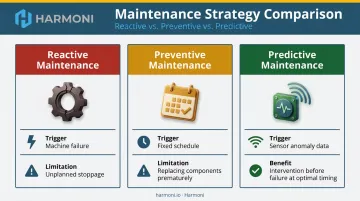
ABB's survey found 21% of businesses still rely on run-to-fail maintenance — despite unplanned downtime costing roughly $125,000 per hour. That gap represents avoidable cost at significant scale.
Predictive maintenance uses sensor data — temperature, vibration, pressure, electrical load — combined with machine learning algorithms to identify patterns that precede failures. The result is maintenance scheduled during planned changeovers rather than disrupting active production runs. Deloitte's research indicates predictive maintenance can increase equipment uptime by 10–20% and reduce overall maintenance costs by 5–10%.
Strategy 6: Integrate ERP, MES, and Shop Floor Systems
Most manufacturing environments have a fundamental integration problem. ERP systems hold job orders and scheduling data, while MES systems manage production execution and machines generate real-time performance data. When these operate in silos, operators work from incomplete information, job costing relies on manually entered estimates, and managers can't see what's actually happening on the floor until production is already behind.
MESA International positions MES as foundational to smart manufacturing — but that value only materializes when MES connects to both ERP planning data and live shop floor machine data in a closed loop.
A unified integration layer resolves this by:
- Feeding job orders and schedules from ERP down to the shop floor
- Pushing actual production data (labor time, machine runtime, scrap, quality) back up to ERP
- Enabling accurate job costing based on what actually happened, not manual estimates
- Giving managers a single operational view across all three data sources
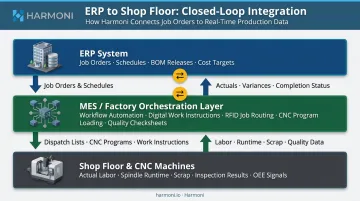
Harmoni operates as this integration layer — connecting ERP systems (Epicor, Infor, JobBoss, ABAS, ODOO), shop floor execution, and CNC machine controls (Mazak, Haas, Fanuc, Heidenhain, Siemens, DMG MORI, Makino, Fadal) without requiring machine replacement.
As one WessDel Manufacturing customer noted, the system integrated with both new and old machines and was working with Epicor out of the box.
Strategies 7–8: Real-Time Visibility and Data-Driven Decisions
Strategy 7: Gain Real-Time Visibility Into Shop Floor Operations
Decisions made on yesterday's data are always reactive. By the time a manually compiled shift report reaches a plant manager, the bottleneck it describes has already affected multiple jobs.
True real-time shop floor visibility means a live operational picture that combines:
- Machine status — running, idle, or in setup
- Operator activity — which operator is at which machine, clocked into which job
- Job progress — where each work order stands against its scheduled completion
- OEE metrics — availability, performance, and quality for each asset
As Quality Magazine notes, real-time monitoring software can detect process deviations during production rather than relying on end-of-line inspection — a distinction that determines whether a quality issue gets caught before or after scrap is made.
Harmoni's shop floor dashboards bring machine data, operator labor data, and ERP job data into a unified view accessible from any device. Visual Factory andon-style stack lights at each workcenter communicate OEE status in real time — green for acceptable performance, red for a condition requiring attention — giving floor supervisors immediate situational awareness without requiring them to check a screen.
Strategy 8: Use Manufacturing Data for Continuous Improvement
Real-time visibility solves today's problems. Historical data prevents tomorrow's.
Production data collected over time reveals patterns invisible in day-to-day operations:
- Which machines have the highest frequency of unplanned stops — and what precedes them
- Which shifts consistently run longer cycle times — and why
- Which jobs have the widest variance between estimated and actual labor hours
- Which operators or workcenters are driving disproportionate quality failures
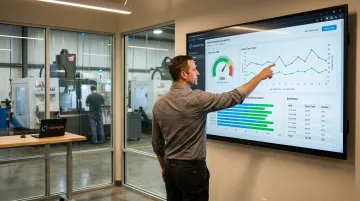
Deloitte found 57% of manufacturers now use data analytics at the facility level — and 78% allocate more than 20% of their improvement budget to smart manufacturing initiatives. The manufacturers gaining competitive advantage aren't just collecting data; they're acting on it.
For Harmoni customers, the continuous improvement case becomes concrete: automatically captured machine runtime and labor data eliminates the manual ERP entry that historically distorted job costing. When cost calculations reflect what actually happened on the floor, job costing becomes accurate enough to sharpen quoting, scheduling, and capacity planning — in that order.
Strategies 9–10: Inventory, Resources, and Organizational Culture
Strategy 9: Optimize Inventory and Resource Management
Inventory inefficiency shows up in two failure modes: too much ties up capital and storage space; too little stops production. NAM's Q3 2022 survey found 78.3% of manufacturing leaders cited supply chain disruptions as a primary business challenge — and NIST MEP confirms that delayed materials directly create work stoppages and missed shipments.
Automated inventory tracking, reorder point management, and material requirements planning (MRP) help manufacturers right-size inventory relative to actual demand and production schedules rather than reactive purchasing decisions.
Labor resource planning deserves equal attention. In high-mix, low-volume environments like CNC machining and precision manufacturing, assigning operators with the wrong skill set to the wrong workcenter is as costly as a material shortage. McKinsey estimates US manufacturers face $17,000–$30,000 per employee in costs tied to labor skills mismatches.
Harmoni's RFID-based labor tracking gives managers real-time visibility into:
- Operator location and active job assignments
- Labor time logged against ERP targets
- Shift coverage gaps before they affect output
This makes staffing decisions proactive rather than reactive — especially on high-mix floors where workcenter skill demands shift throughout the day.
Strategy 10: Secure Management Support and Build a Culture of Accountability
The most sophisticated technology stack underperforms when organizational culture doesn't support it. McKinsey's transformation research is direct on this point: among companies that failed to engage line managers and frontline employees, only 3% reported transformation success. The same research found that companies prioritizing frontline engagement saw productivity improve by over 10% and absenteeism drop by half.
Management support means more than budget approval. It means:
- Making the business case for data-driven production practices visibly and consistently
- Setting clear performance expectations at the workcenter level — not just at the plant level
- Enforcing standardized processes across all shifts, not just during audits
- Using production data to have specific conversations, not generic ones
On the shop floor, accountability looks like:
- Operators who can see their own performance metrics in real time
- Managers who act on exception alerts rather than waiting for shift reports
- Improvement targets grounded in actual production data, not estimates
Harmoni makes this visible at every level — andon lights at each machine signal status in real time, manager dashboards are accessible from any device, and exception alerts reach the right people the moment something goes off track.
Frequently Asked Questions
How to streamline a manufacturing process?
Streamlining starts with identifying where inefficiencies actually occur — in operator workflows, equipment reliability, or system integration gaps. Effective approaches combine workflow standardization, real-time bottleneck monitoring, automation of manual non-value-added steps, and integrated data visibility across ERP and shop floor systems.
What are the five types of software used in manufacturing?
The five core categories are:
- ERP (enterprise resource planning) — handles business planning and scheduling
- MES (manufacturing execution system) — manages shop floor execution
- MRP (material requirements planning) — drives procurement and supply
- Inventory management software — tracks materials and stock levels
- Machine monitoring platforms — capture real-time machine and operator data
What is the biggest challenge in streamlining manufacturing operations?
The execution gap — the disconnect between what planning systems schedule and what actually happens on the floor — is the hardest problem to solve. Closing it requires coordinating people, machines, and systems in real time, not just fixing one element at a time.
How does real-time data visibility help streamline manufacturing?
Real-time visibility allows managers and operators to identify problems as they occur rather than hours or shifts later. This enables faster corrective action, fewer defects caught late in the process, and more accurate job costing than manually compiled end-of-shift reports allow.
What is the difference between preventive and predictive maintenance?
Preventive maintenance follows fixed schedules regardless of actual machine condition. Predictive maintenance uses sensor data and analytics to intervene only when equipment signals an impending failure, reducing both unnecessary scheduled downtime and unexpected breakdowns.
How long does it take to see results from manufacturing process improvements?
Workspace organization and workflow standardization can show measurable gains within days or weeks. Technology integration projects — ERP-MES connectivity, predictive maintenance — typically take several months. Platforms built for rapid deployment, like Harmoni, can go live in weeks without replacing existing equipment.