Introduction
Manufacturers today are caught between tighter margins, a shrinking labor pool, and customers who expect zero-defect delivery on compressed timelines. Deloitte and The Manufacturing Institute project that U.S. manufacturing may need 3.8 million additional workers by 2033 — with 1.9 million of those roles potentially going unfilled. At the same time, NAM's Q1 2025 survey found that 76.2% of manufacturers cited trade uncertainty and 62.3% flagged raw material costs as primary pressures.
For most shops, automation is no longer optional — it's the practical response to those compounding pressures. The problem is that most conversations about it stay abstract, offering broad efficiency promises without explaining what actually changes on the floor.
This article breaks down what shop floor automation actually does: the specific, measurable advantages it delivers across visibility, quality control, and labor productivity — and what happens to shops that keep running without it.
Key Takeaways
- Real-time visibility lets managers catch bottlenecks and downtime while production is still running — not after the shift ends
- Automated process controls prevent scrap and rework by enforcing correct setups before cycles begin
- WessDel documented 17 productive hours gained per employee per month after eliminating manual administrative tasks from operators
- Automation compounds over time: accurate job costing sharpens quoting, fewer errors cut rework, and better data speeds up improvement cycles
- Without automation, shops accumulate hidden costs and operational fragility that compound quietly until they surface as missed deadlines or lost margin
What Is Shop Floor Automation?
Shop floor automation is the use of connected software, machine interfaces, and workflow systems to coordinate and execute production tasks with less manual intervention and more reliable consistency.
The term "automation" often conjures images of robotic assembly lines. In practice, shop floor automation is software-driven — and it applies across every touchpoint where operators, machines, and jobs intersect:
- CNC machine connections — capturing live program execution, cycle times, and machine status
- Operator workcenters — delivering job data, work instructions, and quality checksheets directly at the machine
- ERP integration — automatically pushing labor records, production quantities, and scrap data back into planning systems
- Quality checkpoints — enforcing process steps and capturing inspection data in real time
- Engineering document control — ensuring operators always work from current, approved revisions
The underlying goal is closing the gap between what the ERP plans and what actually happens on the floor. When that gap is visible and managed, production becomes more predictable, errors become traceable, and throughput improves without adding headcount.
Key Advantages of Shop Floor Automation
The advantages below show up in metrics manufacturers already track — cost per part, scrap rate, labor utilization, and on-time delivery — each tied to a specific change in how work is planned, executed, or monitored.
Advantage 1: Real-Time Visibility Into Production Performance
Real-time visibility means knowing — at any given moment — what each machine is doing, what each operator is working on, and how a job is tracking against schedule. Not at the end of a shift. Not after a supervisor walks the floor. Now.
Automation creates this by pulling machine data, operator activity, and ERP job data into a unified view. It replaces the patchwork of spreadsheets, verbal status updates, and whiteboard tallies that most shops still rely on.
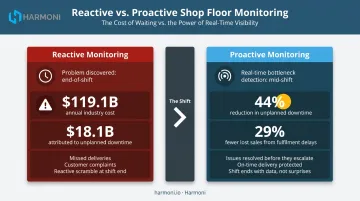
The cost of poor visibility: NIST estimated that preventable maintenance and performance issues cost discrete manufacturers $119.1 billion annually — including $18.1 billion from downtime and $100.2 billion from delays and defects. Establishments that invested heavily in proactive monitoring saw 44% less downtime and 29% fewer lost sales from delays.
The shift from reactive to proactive is the real value here. When a bottleneck appears at 10 a.m., a manager with real-time data can reallocate work, adjust priorities, or address a machine issue before it cascades into a missed delivery. Without that visibility, the same problem gets discovered at end-of-shift — or worse, when a customer calls.
KPIs impacted:
- Overall Equipment Effectiveness (OEE)
- Machine utilization rate
- On-time delivery rate
- Production cycle time
- Mean time to respond to floor issues
Platforms like Harmoni's factory orchestration system bring machine data, ERP workflows, and operator RFID activity together in a single real-time dashboard — giving both managers and floor operators unified operational context without requiring separate monitoring tools.
When this matters most: High-mix, low-volume environments where jobs change frequently, and shops running multiple shifts where problems can go unnoticed across handoffs.
Advantage 2: Reduction in Production Errors, Scrap, and Rework
Most scrap and rework in precision manufacturing doesn't start with a machine failure. It starts with a process execution failure — an operator working from an outdated drawing, a program loaded for the wrong revision, a setup step skipped because it wasn't documented anywhere accessible.
Automation addresses this by embedding process controls directly into operator workflows:
- Confirming setup parameters before a run begins
- Displaying the correct, current revision of a drawing or work instruction
- Automatically loading the right CNC program based on job identification
- Preventing operators from proceeding when conditions aren't met
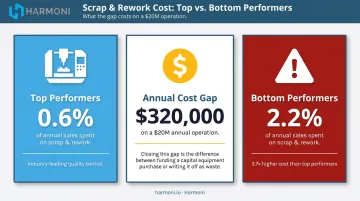
What the data shows: APQC benchmark data shows top-performing manufacturers spend 0.6% of sales on scrap and rework, compared to 2.2% for bottom performers. On a $20 million operation, that gap represents $320,000 annually.
In aerospace and defense environments, the stakes are higher than cost. The Aerospace Corporation documents that human error contributes to over 50% of manufacturing errors in aerospace — including errors from memory-based work, wrong drawing versions, and incorrect specifications. The FAA investigates every Suspected Unapproved Parts report, and Form 8120-11 explicitly states that information is routinely shared with law enforcement for civil and criminal investigations.
Harmoni's engineering revision control ensures operators never work from superseded documentation. When a revision is updated, the change triggers an approval workflow before it reaches any machine — eliminating one of the most common and costly sources of non-conformance.
KPIs impacted:
- Scrap rate
- First-pass yield (FPY)
- Rework hours
- Cost of poor quality (COPQ)
- Customer return and rejection rate
When this matters most: Regulated industries (aerospace, defense, medical device), high-tolerance CNC environments, and shops where operator turnover creates recurring knowledge transfer gaps.
Advantage 3: Elimination of Wasted Operator Time and Improved Labor Accountability
Most shops don't measure what operators do between machining tasks — and that's exactly where productive capacity disappears.
Walking to a shared ERP terminal to log a job change. Hunting for the right job packet. Waiting for a supervisor to deliver updated instructions. Manually entering data that already exists somewhere in the system.
None of this appears in an efficiency report. But it compounds across every operator, every shift.
Measured results from the floor: WessDel, a San Jose aerospace and defense shop running Epicor Kinetic, conducted formal time studies before implementing Harmoni. Their finding: each ERP transaction was consuming an average of 11 minutes per operator. With operators performing multiple transactions throughout the day — clocking in, changing jobs, logging production — the cumulative waste was significant.
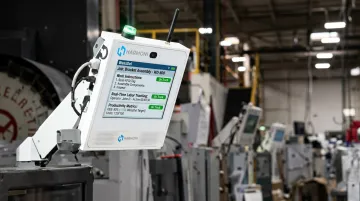
After deploying Harmoni's RFID-enabled machine-side command centers, those same transactions dropped to seconds. The measured result: 17 productive hours gained per employee per month, a 5x return on ongoing platform costs, and a 10% reduction in delinquent jobs.
Automation creates this outcome by:
- Using long-range RFID to automatically identify operators and active jobs at the workcenter — no manual login required
- Delivering work instructions, programs, and quality checksheets directly at the machine
- Automatically pushing labor records, cycle times, and scrap quantities to the ERP without terminal visits
- Generating accurate, real-time time-on-task data for every job
Accurate labor data flows directly into job costing — which means more reliable quoting, tighter margin analysis, and fewer jobs that turn unprofitable mid-run.
KPIs impacted:
- Labor utilization rate
- Productive hours per shift
- Job costing accuracy
- Throughput per operator
- Variance between estimated and actual job hours
When this matters most: Shops with high operator headcount, complex job routing, frequent changeovers, or any environment where job costing drives pricing and capacity decisions.
What Happens When Shop Floor Automation Is Missing
Without automation, the shop floor doesn't stay static. It accumulates hidden costs and operational fragility — usually slowly enough that no single problem triggers action.
Common consequences:
- The same job produces different outcomes depending on which operator runs it, which shift is working, or which drawing version was pulled from the file cabinet
- Mistakes surface after the part is complete — or after it ships — because there's nothing enforcing process at the point of execution
- Managers spend their days responding to problems they couldn't see coming, rather than fixing the processes that caused them
- Manual reporting, program transfers, and job tracking consume operator hours that never appear in any efficiency metric
- Growth stalls because tribal knowledge becomes the bottleneck — new operators take far longer to reach full productivity without standardized, automated workflows
A 2023 survey by Parsec found that 35% of manufacturing professionals still rely on paper-based data collection — and 31% of firms claiming completed digital transformation still collect most of their data through non-digital processes. When data lives on paper, defects get discovered at inspection — or worse, at the customer.
How to Get the Most Value from Shop Floor Automation
Automation delivers its full benefit when it's treated as an operational discipline, not a one-time software deployment. It needs to span three interconnected areas:
- Task automation — removing manual, non-productive steps from operator workflows (job dispatch, labor logging, program transfers, ERP data entry)
- Process control — enforcing correct execution before and during production runs (revision control, setup validation, quality checksheets)
- Observability — capturing and surfacing real-time data for decisions at every level of the organization
Harmoni's factory orchestration platform is built around exactly these three pillars, integrating with existing ERP systems (Epicor, Infor, JobBoss, ABAS, ODOO) and CNC controls (Mazak, Haas, Fanuc, Heidenhain, Siemens, DMG MORI) without replacing existing infrastructure. It deploys in weeks, not months.
One practical note on observability: dashboards and alerts only generate value when they're acted upon. To close the loop between floor data and production planning:
- Schedule regular KPI reviews (weekly at minimum)
- Set alert thresholds for downtime and performance deviations
- Treat floor data as a live operational input, not a periodic report
Harmoni's custom alerts notify managers instantly when machines deviate from expected performance. The platform's Next Gen Shop Communications let operators escalate directly to engineering or maintenance without leaving their workcenter.
Shops that consistently outperform their peers share one habit: they embed floor data into daily decisions. The technology matters far less than whether the organization actually acts on what the system surfaces.
Conclusion
Shop floor automation's core value comes down to execution you can rely on: work that runs the same way every shift, real-time visibility into what's actually happening, and consistency that doesn't hinge on any single operator's habits or memory.
These advantages compound. More accurate job costing improves quoting. Fewer errors reduce rework costs. Better visibility accelerates improvement cycles. WessDel's 17 productive hours recovered per employee per month didn't stay confined to one shift. It changed how the shop planned capacity, priced jobs, and measured performance going forward.
The manufacturers who get the most from automation treat it as an ongoing operational discipline. The system keeps generating data; the shop's job is to keep acting on it.
If you want to see what shop floor automation looks like applied to your specific environment, request a free demo at harmoni.io/demo or reach out to the Harmoni team at (888) 341-4097 or sales@harmoni.io.
Frequently Asked Questions
What is shop floor automation software?
Shop floor automation software connects machines, operators, and production systems to coordinate job execution, reduce manual tasks, and capture real-time performance data. It differs from general ERP or MES software by focusing on the moment-to-moment execution layer — what's actually happening at each machine and workcenter, not just what's planned in the system.
What are the three phases of shop floor control?
The three phases align with NIST and ISA-95 frameworks:
- Order release — dispatching jobs to the floor with the correct instructions and resources
- Order monitoring — tracking progress, machine status, and labor in real time
- Order completion — confirming output and reporting actuals back to the planning system for job costing and scheduling
What are the main benefits of shop floor automation for manufacturers?
The core benefits are reduced scrap and rework, elimination of wasted operator time, real-time visibility into production performance, and more accurate job costing. Together, these reduce per-part cost, improve on-time delivery, and give manufacturers the data needed to quote competitively and improve continuously.
How does shop floor automation improve quality control?
Automation improves quality by enforcing process steps before production begins — ensuring operators have the correct work instructions, current drawing revisions, and validated programs in place before a cycle starts. This prevents errors at their source rather than catching defects after parts are complete or shipped.
What are the top automation tools used on the shop floor?
Commonly used categories include Manufacturing Execution Systems (MES), factory orchestration platforms, machine monitoring software, DNC (Distributed Numerical Control) systems, and RFID-based job tracking. The right combination depends on the shop's ERP environment, machine types, and operational priorities.
What are the five layers of automation?
The ISA-95 hierarchy defines five levels: field devices (sensors, actuators), control systems (PLCs, CNCs), supervisory systems (SCADA, HMI), manufacturing operations management (MES), and enterprise planning (ERP). In practice, these layers rarely communicate automatically. Factory orchestration platforms like Harmoni are designed to close that gap, particularly between CNC controls and ERP systems.