Introduction: What Is Automated Quality Control in Manufacturing?
Automated quality control (AQC) uses sensors, machine vision, AI, robotics, and software to inspect and monitor products and processes without relying solely on human judgment. Critically, it's not just end-of-line inspection — it catches and prevents defects while production is actively running, not after the fact.
Manual inspections are slow, inconsistent, and reactive. Defects surface after the damage is done — a bad batch ships, scrap accumulates, and rework eats into margins. AQC changes that by embedding quality checks directly into the production process.
The business case is substantial. According to ASQ, quality-related costs — including hidden costs — can reach 25% or more of sales. McKinsey's discrete manufacturing research found that digital quality technologies can reduce those costs by 15–20%.
Key Takeaways
- AQC replaces slow, error-prone manual inspection with continuous, technology-driven detection and prevention.
- The primary QC types — incoming, in-process, and final/outgoing — each benefit from different automation approaches.
- Core technologies include machine vision, AI/ML, IoT sensors, robotics, and analytics software.
- Effective AQC requires integration with production workflows and ERP/MES systems, not hardware alone.
- One precision manufacturer cut scrap by 22% in two months with real-time quality monitoring.
Manual vs. Automated Quality Control: Key Differences
Traditional manual inspection has a structural problem: it depends on people checking things at intervals, using judgment that varies by operator, shift, and fatigue level. A human inspector sampling parts every 30 minutes on a high-volume line will always miss defects that occur between checks. Metrology lab bottlenecks compound this further, turning quality into a periodic event rather than a continuous process.
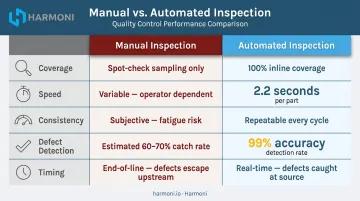
The performance gap is measurable. Assembly Magazine's 2024 analysis of an AI-based car seat inspection system found manual defect detection ranged from 60% to 90%, while AI inspection achieved 99% accuracy. Inspection time dropped from one minute per seat to 2.2 seconds — a productivity shift that manual staffing simply can't replicate.
Where the Real Gap Opens Up
Those numbers reflect a deeper structural difference: timing. Manual QC operates as a checkpoint — periodic, after-the-fact. Automated QC is a continuous function embedded directly in production.
| Factor | Manual Inspection | Automated Inspection |
|---|---|---|
| Coverage | Sampling-based | 100% of parts |
| Speed | Limited by human throughput | Thousands of parts per minute |
| Consistency | Varies by operator and shift | Same criteria, every cycle |
| Defect detection | 60–90% (depending on task) | Up to 99% with AI |
| Timing | Periodic, after-the-fact | Real-time, in-process |
Because defects are caught mid-cycle rather than at a downstream checkpoint, automated systems can halt or adjust production before scrap accumulates — not simply record that it did.
Key Technologies Powering Automated Quality Control Systems
Machine Vision Systems
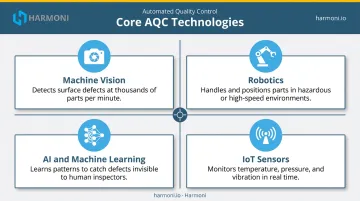
Cameras paired with image-processing algorithms capture high-resolution images of parts to detect surface defects, dimensional deviations, and cosmetic inconsistencies at speeds no human inspector can match. According to Keyence, the human eye processes roughly 10–12 images per second — machine vision systems can inspect thousands of parts per minute.
These systems mount inline on conveyor systems or robotic arms, making them suited for both high-volume and precision manufacturing environments.
Robotics
Robotic arms handle, position, and inspect components in high-speed or hazardous environments where human fatigue or contamination risk makes manual inspection impractical. Consistent part handling also eliminates measurement variation caused by how a part is presented for inspection.
AI and Machine Learning
AI-driven inspection goes beyond detecting known defect types — it learns from historical data to identify subtle patterns invisible to human inspectors. In one documented automotive case, AI-driven inspection achieved:
- 30% reduction in defect rates through continuous pattern learning
- 30-fold cost reduction compared to prior manual inspection methods
- ROI in under two years, improving further as the system accumulated training data
NIST describes this capability as detecting "subtle defects or anomalies through pattern recognition" — a standard that matters most in precision aerospace and medical device manufacturing.
IoT-Connected Sensors
IoT sensors monitor process variables — temperature, pressure, vibration, tool wear — in real time across the production line. McKinsey's discrete manufacturing research found that closed control loops using sensor-based inline quality inspection reduce waste and increase yield by detecting process deviations before defective parts accumulate, not after.
Data Collection and Analytics Software
All of these technologies generate data that's only useful if it drives decisions in real time — not batched into a report at the end of a shift. Statistical Process Control (SPC) is the foundational analytical method here, using control charts to visualize when a process is drifting out of tolerance so operators can intervene before scrap accumulates.
Platforms like Harmoni take this further by integrating quality data with machine performance, operator activity, and ERP records — giving manufacturers a single unified view instead of fragmented, siloed readings.
Benefits of Automated Quality Control in Manufacturing
Improved Accuracy and Consistency
Automated systems apply identical inspection criteria to every part, every cycle — no variation between operators, no degradation across shifts. The difference between 60–90% human detection and 99% automated accuracy represents real defects reaching customers or generating scrap.
Increased Throughput and Productivity
Inline automated inspection eliminates the bottleneck of pulling parts for manual measurement. Systems run 24/7 without staffing constraints and measure more parts per hour with greater dimensional coverage than any manual process can deliver.
Real-Time Error Prevention
When a sensor or vision system flags an out-of-tolerance condition mid-cycle, production can be corrected or halted before a large batch of scrap accumulates. Waiting for an end-of-shift inspection means the problem already ran for hours.
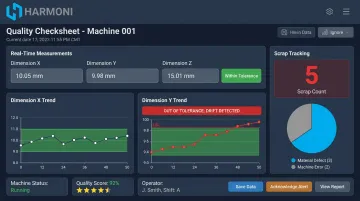
Harmoni's digital quality checksheets put this into practice: operators enter measurements at the machine in real time, and trend graphs surface out-of-tolerance drift before it results in scrap. Operators and managers can see production cycles going off-tolerance before it's too late — not after the damage is done.
That real-time visibility translates directly into cost impact.
Cost Reduction
Quality-related failures hit budgets across multiple categories simultaneously:
- Scrap and rework costs when nonconforming parts consume materials and labor
- Line stoppages caused by defects that weren't caught in process
- Recalls — typically the most expensive failure mode by orders of magnitude
- Dedicated inspection headcount for manual sampling that could be redeployed
- Understated job costs when scrap isn't captured in real time
Harmoni customers have reported a 22% reduction in scrap in two months through real-time quality monitoring and correct job-to-program matching — a result that reflects the combined impact of catching deviations early and eliminating program loading errors.
Workforce and Labor Benefits
The BLS projects zero growth in quality control inspector employment through 2034, despite roughly 69,900 annual job openings. Automated QC eases this labor gap by enabling production operators to run digital checksheets at their machines — no metrology specialist required for routine in-process inspection. Freed-up QC staff can shift to higher-value analysis rather than repetitive sampling.
The 4 Types of Quality Control in Manufacturing
Incoming Quality Control (IQC)
IQC inspects raw materials, components, and supplier parts before they enter production. Automation here — sensor-based material verification, vision inspection of incoming parts — prevents defective inputs from ever reaching the production floor. Problems caught at this stage cost far less to resolve than the same problems discovered downstream.
In-Process Quality Control (IPQC)
IPQC monitors quality parameters during production at key process steps, not only at the end. This is where real-time sensor data and machine vision have the greatest impact on preventing downstream defects. Catching a dimensional deviation at operation 3 prevents it from compounding through operations 4, 5, and 6.
For CNC machining environments, this includes monitoring dimensions, surface conditions, and tolerances while parts are still in production — with results feeding directly back to the operator at the machine.
Final / Outgoing Quality Control (OQC)
OQC inspects finished products before shipment to confirm they meet customer specifications and regulatory requirements. Automated final inspection systems — 3D scanning CMMs, robotic vision systems — enable 100% inspection of outgoing goods rather than statistical sampling. In aerospace, defense, and medical device manufacturing, this isn't optional.
Statistical Process Control (SPC)
SPC uses statistical methods to monitor and control production processes in real time, flagging variation before it produces defective parts. Rather than reacting to failures after the fact, SPC establishes control limits and alerts operators the moment a process drifts outside acceptable range.
In high-mix / low-volume environments, digital quality checksheets and in-process inspection data feed directly into SPC workflows — giving quality engineers a live view of process stability across multiple jobs running simultaneously. This moves quality management from a paper trail into an active control layer.
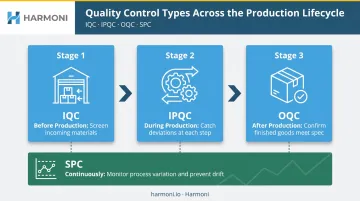
| QC Type | When Applied | Primary Goal |
|---|---|---|
| IQC | Before production | Screen incoming materials and components |
| IPQC | During production | Catch deviations at each process step |
| OQC | After production | Confirm finished goods meet spec before shipment |
| SPC | Continuously | Monitor process variation and prevent drift |
How to Implement Automated Quality Control: From Inspection to Process Orchestration
Map Your Current Quality Failures First
Start by identifying where defects originate, not just where they're caught. Map each production step and find the root causes of recurring quality issues. This determines which automation — inspection hardware, process sensors, orchestration software — will deliver the highest ROI. Deploying a vision system at final inspection when the root cause is a fixturing problem at operation 2 solves nothing.
Select the Right Technology for Your Environment
Technology selection depends on:
- Part geometry — complex contoured parts require 3D scanning; flat surfaces suit 2D vision
- Production volume — high-volume lines justify inline automation; low-volume precision work may suit at-line inspection
- Tolerance requirements — aerospace-grade tolerances need contact measurement or high-precision non-contact systems
- Industry compliance — AS9100, IATF 16949, and ISO 13485 each carry specific documentation and traceability requirements
The framework: inline vs. at-line inspection, contact vs. non-contact measurement, standalone hardware vs. integrated software platforms.
Integrate Across the Full Production Stack
Hardware alone is insufficient when quality data stays siloed. A vision system that flags a defect but doesn't trigger a workflow response (stopping a job, alerting an operator, updating ERP records) has only solved half the problem.
Effective automated QC requires integration with ERP and MES systems so quality signals drive real-time production responses. A factory orchestration platform like Harmoni adds a critical layer here: sitting between machines, operators, and ERP/MES systems, it ensures quality deviations are immediately coordinated with the right people and processes rather than buried in a report reviewed hours later.
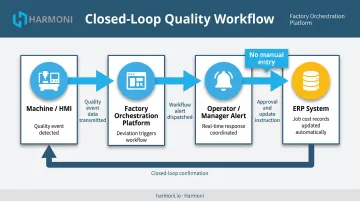
Closed-loop scrap tracking illustrates this well. When a scrap event occurs in Harmoni, the quantity and reason are captured at the machine HMI and automatically pushed to the connected ERP (Epicor, Infor, JobBoss, ABAS, ODOO, and others) with no manual entry and no reconciliation lag. That direct link between shop floor quality events and ERP job cost records is what turns quality data into accurate job cost visibility.
Address Workforce Readiness and Change Management
Employee resistance and skill gaps are the most common implementation barriers. Practices that ease the transition:
- Communicate clearly that automation augments workers, it doesn't replace them
- Provide targeted training on new tools before full deployment
- Use a phased rollout that builds operator confidence before scaling
- Involve frontline operators in system design — their feedback on checksheet usability improves adoption
The WessDel case study offers a useful data point here: after implementing Harmoni's platform, the company's president noted that "even operators love using it — they appreciate the automation."
Define Metrics and Measure ROI
Establish baseline metrics before implementation so improvement is measurable:
- Defect rate (parts per million or percentage)
- Scrap percentage by job or work center
- Inspection throughput (parts inspected per hour)
- Cost of quality (scrap + rework + inspection labor)
- Rework as a percentage of total production hours
Modern automated QC platforms generate the data needed to track these metrics continuously — not just at implementation kickoff.
Frequently Asked Questions
What is automated quality control in manufacturing?
Automated quality control uses technology — including sensors, machine vision, robotics, and AI — to inspect and monitor products and processes without manual human intervention. It delivers faster, more consistent defect detection than traditional methods and operates continuously rather than at periodic checkpoints.
What are some examples of automated manufacturing quality control?
Common examples include:
- Inline machine vision systems that inspect every part on a conveyor for surface defects
- Robotic arms measuring dimensional tolerances on machined components
- IoT sensors monitoring temperature and pressure in real time
- AI-driven software that flags process deviations before a batch is completed
What is the 80/20 rule for automation?
In manufacturing quality, the 80/20 rule (Pareto Principle) means that 80% of defects typically stem from 20% of causes. Automation efforts should target those high-impact causes first rather than automating everything at once — concentrating investment where it eliminates the most defects.
What are the 4 types of quality control in manufacturing?
The four types are:
- IQC (Incoming Quality Control) — inspects supplier materials before they enter production
- IPQC (In-Process Quality Control) — monitors quality during active production runs
- OQC (Final/Outgoing Quality Control) — verifies parts meet spec before shipment
- Process Quality Control — tracks the consistency of manufacturing processes over time
What are the biggest challenges of implementing automated quality control?
The most common barriers include:
- High upfront technology costs
- Integration complexity with existing ERP and MES systems
- Employee resistance or skill gaps in operating new tools
- Choosing the right inspection technology for your specific parts and production environment
How does automated quality control reduce manufacturing costs?
AQC cuts costs across multiple fronts:
- Minimizes scrap and rework by catching defects earlier
- Prevents costly product recalls
- Reduces reliance on manual inspection labor
- Eliminates downtime from defects that go undetected mid-run
- Enables accurate job costing through real-time data capture at the machine
Platforms like Harmoni close this loop by connecting machine-level quality data directly to ERP job records, giving shops a clear picture of true production costs without manual data entry.