
That gap between what's actually happening on the floor and what management can see is where inefficiency compounds. A machine goes down at 9 AM. By the time it shows up in a report, it's 4 PM. The damage is already done.
Shop floor data collection gets discussed as a digital transformation initiative, but its real value is more concrete than that. It shows up in fewer scrapped parts, more accurate quotes, and operators who spend time on production instead of paperwork. According to the Manufacturing Leadership Council, 70% of manufacturers still collect data manually — even as data volumes continue to grow.
This article breaks down the practical advantages of shop floor data collection systems: not what they claim to do in theory, but what they consistently deliver when applied correctly in manufacturing environments.
Key Takeaways
- Shop floor data collection captures production data — machine status, cycle times, labor activity, quality outcomes — automatically and in real time
- Real-time visibility lets managers catch and correct problems before they compound into scrapped parts or missed deadlines
- Automated capture eliminates the transcription errors and missing records that manual processes create
- Accurate labor and machine time data makes job costing reliable rather than estimated
- Structured data collection shifts manufacturing operations from reactive firefighting to informed, proactive decision-making
What Is a Shop Floor Data Collection System?
A shop floor data collection system captures operational data — machine status, cycle times, part counts, labor inputs, quality outcomes, and order progress — automatically and in real time, directly from machines, operators, and connected systems.
These systems sit at the intersection of the machine floor and management decision-making. Data flows into ERP, MES, and reporting platforms to give a complete, current picture of production performance. That unified view is what allows supervisors, engineers, and planners to respond to actual conditions — not shift-end summaries or operator recollections.
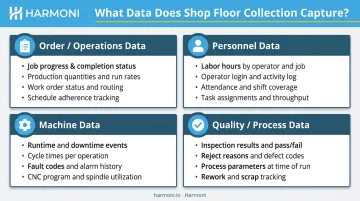
The four core data categories captured:
- Order/operations data: job progress, quantities completed, order status
- Personnel data: labor hours logged, operator activity, attendance
- Machine data: runtime, downtime events, cycle times, fault codes
- Quality/process data: inspection results, reject reasons, process parameters
The system is a means, not an end. What matters is accurate, timely information — the kind that enables faster decisions and keeps production running predictably rather than lurching from one unplanned disruption to the next.
Key Advantages of Shop Floor Data Collection Systems
The advantages below are grounded in operational outcomes manufacturers actively measure: cost, throughput, quality, labor utilization, and risk. These aren't theoretical improvements — they reflect what changes in day-to-day production when data capture is automated and consistent.
Advantage 1: Real-Time Production Visibility
Shop floor data collection replaces delayed, manually compiled reports with a continuous view of what's happening across every machine and workstation. Order progress, machine uptime, operator activity, and output rates become immediately visible without walking the floor or waiting for end-of-shift summaries.
Data flows automatically from machines, control systems, and operator inputs into unified dashboards. Platforms like Harmoni bring machine data, ERP workflows, and operator context together in a single view through real-time machine monitoring, RFID-based labor tracking, and Visual Factory andon-style indicators. This closes the gaps that appear when these data sources live in separate systems.
Why it matters:
Production problems are almost always cheaper to fix in the moment than after a batch is complete. Delays in visibility translate directly into scrap, missed deadlines, and overtime. When managers can see a bottleneck developing in real time, they can reallocate labor, adjust scheduling, or intervene before a delay cascades downstream.
Aberdeen's research found that MES/MOM users achieved 6% higher on-time shipments and 2x better total-cost-per-unit improvement over two years compared to non-users — an outcome that starts with having accurate, timely floor data.
KPIs this visibility directly impacts:
- Machine utilization rate
- OEE (Overall Equipment Effectiveness)
- On-time delivery rate
- Average response time to downtime events
Where this matters most: High machine count environments, mixed product types, tight delivery schedules, and anywhere a single bottleneck machine affects downstream operations — common in aerospace, defense, and precision CNC job shops.
Advantage 2: Error Reduction and Quality Improvement
Automated shop floor data collection removes the most common sources of production errors: manual data entry, missing context, and operators relying on memory or paper-based instructions.
When the system captures data directly from machines and operator inputs at the point of activity, transcription errors disappear. Quality outcomes — scrap rates, reject reasons, out-of-spec events — are recorded accurately and immediately. Structured workflows also ensure operators complete required steps before moving to the next operation, rather than skipping checkpoints under time pressure.
The scale of manual error is well-documented. Quality Magazine reports that average manual data-entry error rates run around 1%, and two-stage manual systems (where data is recorded on paper and later typed) may show errors in 40% of records. In a high-mix precision environment running hundreds of operations per day, those error rates compound fast.
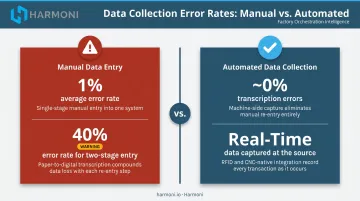
The cost consequence goes beyond the error itself. The ASQ defines internal failure costs as scrap and rework before delivery, and external failure costs as warranty claims, repairs, and returns after delivery. Catching a defect at the source is exponentially cheaper than discovering it after the part ships.
KPIs directly impacted:
- Scrap rate
- First-pass yield
- Rework hours
- Cost of quality
- Defect rate per order
Where this matters most: Regulated industries — aerospace, defense, medical device manufacturing — where traceability and documentation are mandatory. Harmoni's digital checksheets support AS9100, ISO 13485, and IATF 16949 compliance by creating auditable quality records per job, with real-time SPC-style charts that surface trends before defects escalate.
Advantage 3: Accurate Job Costing and Labor Visibility
Shop floor data collection provides a precise, real-time account of how labor hours, machine time, and materials are consumed against each job. This enables true post-job costing rather than estimates built on standard times.
By automatically capturing RFID-based job clock-ins, machine runtime per operation, and output quantities, the system builds an accurate record of actual versus planned costs. In manual environments, this gap typically surfaces only after the job ships — too late to correct.
The revenue stakes are real. Modern Machine Shop research shows that most shops land only about one-third of quoted jobs, and an average shop can spend as much as $1,750 per week on quotes it doesn't win. Without accurate cost data, shops either underprice won business (losing margin) or overprice quotes (losing bids unnecessarily). Either way, the business absorbs the cost of the inaccuracy.
Labor visibility shifts alongside costing accuracy. When operators know their time is tracked against specific jobs in real time, idle time and unrecorded downtime become visible rather than buried in aggregate numbers.
Harmoni captures this through RFID-based job login, automated machine runtime recording, and structured downtime categorization. Events are classified as changeover, breakdown, material wait, operator wait, or quality hold — so improvement efforts target the right root causes.
KPIs directly impacted:
- Actual vs. standard cost per job
- Labor utilization rate
- Setup-to-run ratio
- Gross margin by job or customer
- Capacity utilization
Where this matters most: Contract manufacturers and job shops that quote and price each order individually. Inaccurate cost data directly erodes profitability on every job, making this one of the highest-ROI applications of shop floor data collection.
What Happens Without Structured Data Collection
Operating without shop floor data collection doesn't just mean missing information — it means making decisions based on the wrong information.
The most common consequences:
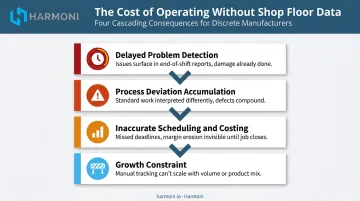
- Problems surface in end-of-shift reports or weekly reviews — after the damage is done. Managers spend time fixing issues instead of preventing them.
- Without real-time data, standard work gets interpreted differently by different operators, and deviations accumulate until they produce scrap or customer complaints.
- Inaccurate cycle time records drive poor scheduling and missed delivery dates. Job costs erode margin quietly, visible only at the accounting level — after the job has closed.
- Manual data collection doesn't scale. As production volume or product mix increases, the inability to track what's actually happening becomes a hard constraint on growth.
Aberdeen's research found that 55% of manufacturers cited operational inefficiencies — waste, delays, and rework — as a significant burden, and 64% faced sustained pressure to reduce costs. Without structured data collection, there's no reliable mechanism to find where that waste is actually occurring — let alone act on it.
How to Get the Most Value from a Shop Floor Data Collection System
The system delivers maximum value when data capture is complete and consistent across all machines, workcenters, and operator touchpoints. Partial adoption creates gaps that undermine the accuracy of every downstream analysis.
Three practices that separate high-performing implementations:
Cover the entire floor, not just high-visibility areas. A single uncaptured workcenter creates a blind spot in every report that touches that cell. Harmoni connects to major CNC controls — Mazak, Haas, Fanuc, Heidenhain, Siemens, DMG MORI, Makino, and Fadal — plus older equipment via RS232, Ethernet, and USB, so no machine gets left out.
Establish review cadences that turn data into action. Daily reviews of downtime patterns and weekly cost variance checks are what convert collected data into actual process improvements.
Integrate deeply with ERP and quality systems. Shop floor data collection creates the most value when it connects to scheduling, costing, and quality workflows. Harmoni's bi-directional ERP integration with Epicor, Infor, JobBoss, ABAS, ODOO, and others pushes machine-floor data directly into planning, costing, and continuous improvement — no manual re-entry required.
Done right, shop floor data collection gives managers the visibility to act before problems escalate, operators the context to execute correctly, and every job a verified cost record when it ships.
Frequently Asked Questions
What is shop floor data collection?
Shop floor data collection is the process of capturing production-related data — including machine status, cycle times, part counts, labor activity, and quality outcomes — directly from the shop floor. Modern systems do this automatically and in real time, feeding data into ERP, MES, and reporting platforms without requiring manual entry.
What are the 4 types of data collection in manufacturing?
The four core types are:
- Order data: quantities, job progress, order status
- Personnel data: labor hours, attendance, operator activity
- Machine data: runtime, downtime, cycle times, fault codes
- Quality/process data: inspection results, reject reasons, process parameters
Shop floor data collection systems typically capture all four simultaneously.
What is an example of good shop floor practice?
A good practice is ensuring every operator logs on to a job at the start of an operation via RFID, machine runtime is captured automatically throughout, and any downtime event is categorized with a reason code before production resumes. This creates an accurate record of every job without adding administrative burden to the operator.
How does automated shop floor data collection differ from manual data collection?
Manual data collection relies on operators recording information by hand or in spreadsheets — introducing delays, transcription errors, and missing records. Automated systems capture data directly from machines and operator inputs in real time, eliminating these failure points and making data immediately available for decisions.
What KPIs does shop floor data collection help track?
Key metrics include OEE, machine utilization, first-pass yield, scrap rate, actual vs. standard job cost, labor utilization, and on-time delivery. These KPIs are only reliable when the underlying data is captured consistently — which is what a properly implemented shop floor data collection system ensures.
How long does it take to implement a shop floor data collection system?
Timelines vary based on machine count, existing infrastructure, and ERP integration requirements. Manufacturing platforms like Harmoni — which supports diverse machine controls and major ERP systems natively — can deploy across a full shop floor in weeks, without requiring machine replacement or custom development.