The reactive service model is increasingly hard to defend. Margins are tighter, customers have more options, and competing machine builders are starting to offer remote monitoring as part of their standard service packages. Staying reactive isn't a neutral choice anymore—it's a competitive liability.
Remote machine monitoring isn't just an IT upgrade. It's a structural change in how machine builders deliver post-sale value, protect customer relationships, and differentiate in a crowded market.
Key Takeaways
- Remote monitoring lets machine builders diagnose customer equipment, resolve issues, and validate performance from any location — no dispatch required
- It shifts service from reactive break-fix calls to proactive intervention and predictive maintenance
- Key outcomes: fewer on-site visits, faster resolution, data-driven design improvements, stronger customer retention
- Machine builders without remote monitoring face rising service costs, harder warranty disputes, and preventable customer churn
- Unifying machine data with ERP workflows and operator context delivers deeper insight than raw sensor feeds alone
What Is Remote Machine Monitoring?
Remote machine monitoring is the ability to collect and act on real-time performance data from machines installed at customer siteswithout requiring physical presence. It relies on IoT sensors, edge devices, cloud processing, and real-time dashboards to deliver machine health information to service teams wherever they are.
For machine builders specifically, remote monitoring isn't just an internal operations tool—it's a post-sale capability embedded in the machines they sell and service. Every unit in the field becomes a live data source.
What it actually captures:
- Machine states (running, idle, faulted, alarmed)
- Cycle counts and utilization rates
- Spindle load and feed rate data
- Temperature and vibration anomalies
- Alarm codes and threshold exceedances
The goal is concrete: faster service response, higher uptime at customer sites, and smarter product development. These outcomes matter to both machine builders and the customers running their equipment.
Key Advantages of Remote Machine Monitoring for Machine Builders
The advantages below aren't theoretical. They map directly to operational outcomes machine builders can track: service efficiency, customer retention, cost avoidance, and competitive positioning.
Predictive Maintenance That Prevents Customer Downtime
Remote monitoring enables machine builders to detect early warning signals—abnormal vibration, temperature spikes, spindle anomalies—before a failure occurs at the customer's facility.
In practice, this looks like: machine data streams continuously, rules-based or AI-driven analytics flag anomalies, and service teams receive alerts that allow them to act before the customer even notices a problem. DMG MORI's WALC CARE system demonstrates this concretely—it can detect spindle and feed-axis abnormalities more than five months before an operator notices a problem.
Why this matters financially:
Unplanned downtime is expensive—not just for customers, but for machine builders who get associated with it. According to Deloitte, unplanned downtime costs industrial manufacturers an estimated $50 billion annually, and poor maintenance strategies can reduce plant productive capacity by 5% to 20%.
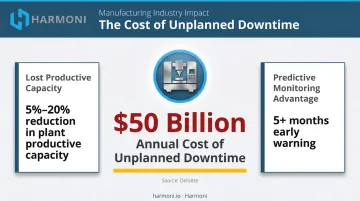
Proactive alerts prevent the entire failure cycle: the emergency call, the scramble to diagnose remotely with no data, the on-site visit, and the follow-up visit when the first one didn't fix it.
They also allow service teams to pre-stage parts, pre-schedule technician time, and resolve issues in a single coordinated action rather than three reactive ones.
KPIs impacted:
- Unplanned downtime at customer sites
- Mean time to repair (MTTR)
- Service call frequency
- Warranty claim costs
- Customer satisfaction scores
When this matters most: High-production environments—aerospace, defense, precision CNC machining—where even hours of downtime translate directly to missed deadlines and strained customer relationships. Mazak notes that spindle downtime can hold up an entire production process and directly compromise customer relationships.
Fewer On-Site Service Visits and Faster Remote Resolution
With live machine data, service teams can remotely confirm alarm states, diagnose faults, and often resolve issues without dispatching a technician. When a site visit is genuinely needed, teams arrive already knowing what parts and tools are required—eliminating the diagnostic trip entirely.
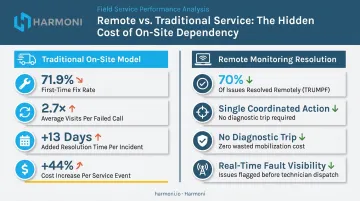
This matters because the traditional on-site model is expensive in ways that compound. Aquant's 2024 Field Service Benchmark Report—drawn from over 24 million work orders across 145 service organizations—shows the cost clearly:
- Median First Time Fix Rate for industrial machinery is 71.9%, meaning nearly 3 in 10 visits don't resolve the issue
- A failed first visit results in 2.7 total visits on average
- Failed first visits add approximately 13 days to resolution time and increase resolution cost by 44%
- Bottom-performing organizations see resolution costs 122% higher than top performers
Remote diagnostics attack this problem directly. TRUMPF reports that approximately 70% of technical issues can be resolved through remote support without a physical site visit—a figure that demonstrates what's possible when service teams have live machine data to work from.
KPIs impacted:
- On-site service visit frequency
- Service response time
- Service team utilization
- Cost per service event
- Customer retention rate
When this matters most: Machine builders with geographically dispersed customers or lean service teams where every truck roll carries meaningful travel overhead. Remote resolution is also the difference between a satisfied customer who barely noticed the issue and one who waited three days for a technician to drive out and look at an alarm code.
Data-Driven Design Improvement and Competitive Differentiation
Remote monitoring generates a continuous stream of real-world performance data across every machine in the field—usage patterns, cycle times, failure modes, environmental conditions. Machine builders who collect and analyze this data gain a feedback loop that competitors relying on customer-reported issues simply don't have.
What this feedback loop enables:
- Identifying systemic weaknesses across the installed base before they become widespread failures
- Validating design changes with actual field data rather than lab assumptions
- Building maintenance schedules tied to real usage patterns instead of calendar time
- Developing service contracts backed by evidence, not guesswork
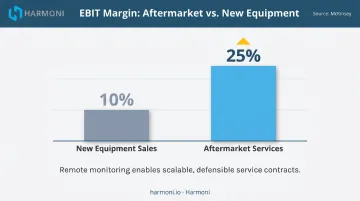
That feedback loop also redefines the machine builder's commercial position. According to McKinsey, aftermarket services carry average EBIT margins of 25% versus 10% for new equipment sales. Remote monitoring is the infrastructure that makes premium service contracts defensible and scalable.
Moving Beyond Raw Machine Metrics
Raw sensor data tells you a machine is running hot. It doesn't tell you whether that's because of a process issue, an operator error, or a design flaw—and it doesn't connect to the ERP context that shows whether the affected job was already behind schedule.
Platforms that unify machine signals with ERP workflows and operator activity deliver a materially different level of insight. Harmoni's factory orchestration platform does exactly this—combining machine data, ERP transactions, and operator activity into a single operational view across Fanuc, Haas, Mazak, Siemens, DMG MORI, and other major CNC controls.
That unified context helps machine builders and their customers understand not just what happened, but why.
KPIs impacted:
- New service contract attach rate
- Customer lifetime value
- Product return and warranty rates
- Net promoter score
- Time-to-design-improvement cycles
When this matters most: Highly competitive machine tool categories where hardware specs are relatively comparable. Post-sale service quality becomes the primary differentiator—and remote monitoring is what makes that differentiation visible and measurable.
What Happens When Machine Builders Skip Remote Monitoring
Without remote monitoring, service teams fly blind until a customer calls with a problem. Then comes the scramble: attempt remote diagnosis with limited data, escalate to an on-site visit that may or may not identify the root cause, order parts, schedule a return trip, and hope the same failure doesn't repeat in six weeks.
This reactive approach creates real business risks:
- Customers in aerospace, defense, and medical track downtime carefully. A machine builder tied to repeated unplanned outages doesn't stay on the preferred vendor list for long
- Without field data, warranty claims become subjective disputes. Objective machine records resolve them faster — without that data, every claim is a negotiation with no clear ground truth
- Aquant's data shows failed first visits average 2.7 total dispatches and raise resolution cost by 44%. Every reactive service event compounds that cost further
- VDMA research found 81% of mechanical engineering companies were already tackling predictive maintenance intensively — machine builders without remote monitoring are visibly behind that curve
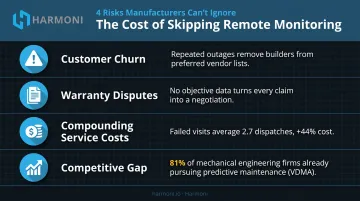
That gap compounds annually. More reactive dispatches, slower resolutions, and customers who notice when a competitor calls them before anything breaks — that's the business case remote monitoring is quietly winning against those who skip it.
How to Get the Most Value from Remote Machine Monitoring
Remote monitoring delivers growing value when treated as a continuous service practice, not a one-time technology installation. The return builds when data is reviewed regularly, alerts are acted on promptly, and insights flow back into service and design decisions.
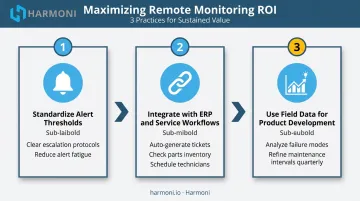
Three practices that maximize ROI:
Standardize alert thresholds and escalation workflows. Service teams need to know exactly how to respond when monitoring flags an issue. Clear protocols reduce response latency and prevent alert fatigue—two failure modes that undermine otherwise good monitoring infrastructure.
Integrate machine alerts with ERP and service management workflows. When a flagged machine condition automatically generates a service ticket, checks parts inventory, and schedules technician time, the loop from detection to resolution closes without manual coordination. Harmoni's platform supports this kind of ERP integration across Epicor, Infor, JobBoss, ABAS, and ODOO, connecting machine events to operational workflows without replacing existing systems.
Use aggregated field data to inform product development. Treat the installed base as a continuous R&D feedback channel. Analyze failure modes, refine preventive maintenance intervals, and feed patterns into design cycles on a defined cadence—starting quarterly and adjusting based on failure pattern volume.
Build vs. Buy
The three practices above assume a monitoring platform is already in place. For machine builders still deciding how to get there, four factors drive the build vs. buy decision:
- Speed-to-deployment — how quickly the system can go live across existing equipment
- Engineering maintenance burden — the ongoing internal staffing required to keep it running
- Machine compatibility — breadth of CNC controls and equipment types supported out of the box
- ERP integration depth — whether machine events connect natively to operational workflows
Building internally offers full customization but requires sustained engineering investment that most machine builders aren't staffed to maintain indefinitely. Third-party platforms typically deploy faster and come with pre-built connectors for major CNC controls and ERP systems—cutting implementation time and integration effort. Harmoni, for example, deploys in weeks across existing equipment with no machine replacement required, supporting major CNC controls and ERP platforms out of the box.
Conclusion
Remote machine monitoring changes what machine builders can offer after the sale. Instead of waiting for customers to report problems, service teams can act before failures occur—resolving issues faster, with fewer site visits, and with the field data needed to improve both service quality and product design over time.
The advantages compound. Each prevented failure builds customer trust. Fewer truck rolls lower service costs directly. Design improvements informed by real field data reduce future failures before they become a pattern. The cumulative effect is a stronger competitive position and deeper customer loyalty that's hard to replicate through hardware specs alone.
In competitive markets, remote monitoring has moved from differentiator to a baseline expectation. Machine builders who still treat it as optional are falling behind competitors who've already made it standard—and their customers are noticing.
Frequently Asked Questions
How does remote monitoring for industrial machines work?
IoT sensors on the machine capture performance data—vibration, temperature, cycle counts, alarm states—and transmit it via network or cloud connection to a central platform. Service teams access real-time dashboards and automated alerts from anywhere, allowing them to diagnose issues and act without an on-site visit.
How do I know if my machines need remote monitoring?
Several patterns point to a clear need. Frequent service calls, resolution times stretching past two to three days, recurring unplanned downtime, or warranty disputes that are hard to resolve without objective field data—each is a signal that remote monitoring would deliver immediate value.
Should machine builders build their own remote monitoring system or use a third-party platform?
Both paths have trade-offs:
- Build internally: Full customization, but requires sustained engineering investment and ongoing maintenance
- Third-party platform: Faster deployment, broader machine compatibility, and pre-built ERP integrations out of the box
For most machine builders, a third-party platform is the lower-risk starting point. The engineering time saved is better spent building machines.
What ROI can I expect from remote monitoring for industrial equipment?
ROI varies by service volume and machine type, but Deloitte's research across manufacturing indicates predictive maintenance can reduce breakdowns by up to 70%, cut maintenance costs by 25%, and increase equipment uptime by up to 20%. Savings compound through reduced on-site visits, lower warranty costs, and improved customer retention.
What security considerations apply to remote machine monitoring?
Key considerations include encrypted data transmission, clear data ownership agreements between machine builder and customer, and role-based access controls within the monitoring platform. For defense-sector deployments, CMMC and ITAR alignment requires additional controls—Harmoni offers a Government Cloud deployment specifically for manufacturers handling Controlled Unclassified Information.
How long does it take to implement remote monitoring on existing machines?
Deployment timelines vary by platform and machine type. Modern platforms designed for existing equipment—Harmoni deploys in weeks with no machine replacement required—can be operational quickly. ERP integration complexity is the primary factor affecting timeline, not hardware installation.