
This gap between when problems occur and when management learns about them is the central failure of reactive shop floor management — and it's expensive. NIST research found that manufacturers in the top quartile of reactive practices experience 3.3x more downtime and 16x more defects than those who manage proactively.
Shop floor management (SFM) is the discipline that closes that gap. Not by adding more meetings or reports, but by building daily leadership habits, visual tools, and communication structures that surface problems while there's still time to act.
This guide covers what lean SFM actually is, its three philosophical pillars, the practical components that create lasting culture change, a four-step implementation roadmap, the metrics that matter, and how technology amplifies what you've built.
Key Takeaways
- Lean SFM is a daily leadership discipline, not a set of tools — culture determines whether it works
- The 3G framework (Gemba, Genchi Genbutsu, Genjitsu) provides the behavioral foundation for lean culture
- Visual management, structured stand-ups, and standardized work only deliver results when they function as a unified system
- Track OEE, First-Pass Yield, and employee improvement participation to measure both operational performance and cultural progress
- Technology amplifies lean culture — it cannot substitute for one
What Is Shop Floor Management — and Why Culture Is the Foundation
Shop floor management is a leadership and operational methodology built on one principle: manage production where work actually happens, in real time, with the people doing the work.
This distinguishes SFM from production scheduling, ERP-driven planning, or end-of-day reporting. Those systems describe what should happen or what already did. SFM addresses what's happening right now — and builds the daily habits to respond before small issues become production losses.
Tools Alone Don't Create Change
Organizations frequently deploy lean tools — whiteboards, dashboards, stand-up meetings — and see little improvement. The Lean Enterprise Institute identifies this pattern directly: lean tools fail to change culture when they're used as action plans rather than mechanisms for people to see, discuss, and solve problems together.
A whiteboard displaying yesterday's OEE is a tool. A team that reviews it every morning, owns the number, and drives corrective action — that's culture.
SFM's roots trace to Toyota and the Toyota Production System, where the methodology and the culture were never separate. Toyota defines the TPS not primarily as a production system, but as a manufacturing philosophy built on complete waste elimination — something that requires cultural commitment, not just process compliance.
Who Benefits Most
SFM delivers the most value for teams trying to connect daily floor activity to strategic improvement goals — not just hit today's production number. It's most impactful for:
- Production supervisors managing real-time output and operator accountability
- Plant managers bridging floor execution with operational KPIs
- Continuous improvement professionals building sustainable lean systems
- Manufacturers in precision machining, aerospace, defense, and automotive environments
The Three Pillars of Lean Shop Floor Management
The 3G framework (Gemba, Genchi Genbutsu, and Genjitsu) forms the philosophical foundation of lean SFM. These aren't abstract concepts. They're daily leadership behaviors that, practiced consistently, produce cultural transformation over time.
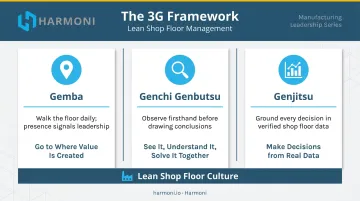
Gemba: Go to Where Value Is Created
Gemba translates to "the real place" — in manufacturing, the production floor. The principle is direct: effective leaders must be physically present where work happens, not managing from offices or conference rooms.
Leaders who practice Gemba consistently gain firsthand visibility into bottlenecks, workarounds, and informal processes that never appear in reports. A supervisor working off a dashboard alone will never see that operators skip step 4 because the fixture makes it physically awkward, or that two machines idle every afternoon waiting on the same inspection gauge.
Scheduled Gemba walks, conducted with curiosity rather than surveillance, also build trust. When frontline workers see leadership present and genuinely interested in their daily reality, they're more likely to surface problems rather than hide them.
The results can be significant. A NIST MEP case study reports a manufacturing team identified more than 60 problems following a structured Gemba walk, ultimately achieving $111,000 in annual cost savings.
Genchi Genbutsu: See It, Understand It, Solve It Together
Genchi Genbutsu ("go to the source to verify") goes beyond observation. It requires active leadership participation in problem-solving at the point of work.
Rather than delegating issues upward or assigning them to an improvement team, this principle means managers engage directly with operators to understand and resolve problems. The practical target: resolve one specific problem per shift, with the operator, at the machine.
This breaks down the hierarchical barriers that keep frontline workers from speaking up. Consistent leadership presence — asking questions, working through problems together — signals that every perspective on production reality matters.
Done right, Genchi Genbutsu shifts problem-solving from a top-down assignment to a shared habit:
- Managers engage at the machine, not from a conference room
- Operators are asked to explain the problem, not just report it
- Solutions are developed collaboratively, increasing buy-in and follow-through
Genjitsu: Make Decisions from Real Data
Genjitsu is the discipline of anchoring every decision in verified, factual data rather than assumptions, gut instinct, or what the last shift supervisor recalled verbally.
Practical applications include:
- Posting the previous shift's OEE before the morning stand-up begins
- Maintaining KPI boards visible to the entire team, updated in real time
- Requiring problem-solving discussions to start with data, not opinions
Without this discipline, decisions default to informal impressions of how the shift went. That breeds inconsistency, makes accountability impossible to enforce fairly, and guarantees the same problems resurface shift after shift.
Core Components That Build a Lean Shop Floor Culture
The 3G principles describe how lean leaders think. These components describe what they do every day. Each reinforces the others — lean culture emerges when they operate as a connected system.
Leader Standard Work
Lean culture requires leaders to have standardized, scheduled behaviors, not just reactive floor visits when something goes wrong.
Leader Standard Work (LSW) includes five major elements: Gemba walks, reflection meetings, response to andon calls, creating accountability, and mentoring people. When leadership behavior is structured and visible, it models the consistency standard operators are expected to follow.
Consider what operators observe when their supervisor conducts a Gemba walk every morning at 7:15 and reviews the board every afternoon at 2:00. That visible routine communicates one thing clearly: discipline and follow-through are non-negotiable.
Visual Management and SFM Boards
Visual boards — physical or digital — serve as the team's shared source of truth. Their purpose is making the invisible visible: problems, priorities, and progress should be readable by anyone on the floor within seconds.
A widely used organizing framework is SQCDP (Safety, Quality, Cost, Delivery, People), which structures board content across five dimensions of daily operational health. Effective boards show:
- Real-time production status vs. target
- Open safety incidents and corrective actions
- Quality metrics and first-pass yield trends
- Delivery performance and schedule attainment
- People-related issues, attendance, and improvement participation
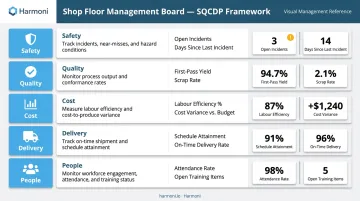
A number on a board with no owner and no response is worse than no number at all — it signals that metrics are performative, not functional.
Structured Daily Stand-Ups and Cascade Communication
Short, daily stand-ups anchored to the visual board — ten minutes maximum — replace long meetings and email chains with real-time team alignment. The agenda is fixed: safety, quality, delivery, and people. Deviations get brief escalation decisions, not extended root-cause discussions.
Cascade communication ensures information moves both directions. Floor-level problems reach the right decision-makers quickly. Strategic priorities translate into daily floor activities. Without this structure, critical information stalls at each organizational layer.
Standardized Work and Process Confirmation
Lean culture depends on consistent execution of documented standard work. Documentation alone isn't enough: process confirmation requires supervisors to periodically verify that operators are actually following standards, not just assuming they are.
The gap between written procedure and actual practice is where quality escapes, rework, and training inconsistencies live. Closing it transforms tribal knowledge into institutional reliability.
Harmoni's platform supports this directly. When operators clock into jobs via RFID, the system automatically surfaces the correct digital work instructions and setup sheets for that specific part and revision. There's no ambiguity about what the current standard requires.
Sustainable Problem-Solving (PDCA and Kaizen)
The PDCA cycle — Plan, Do, Check, Act — provides the structural backbone for improvement work. The most commonly paired tools include:
- 5 Whys root-cause analysis for drilling to underlying causes
- A3 problem-solving reports for structured, single-page documentation
- Kaizen events for concentrated, team-led improvement sprints
- Employee suggestion systems for capturing frontline insight between events
Together, these tools make improvement a daily habit rather than a special event.
The cultural requirement: problems must be welcomed as improvement opportunities, not hidden to avoid blame. When frontline workers see their ideas implemented and credited publicly, ownership of improvement transfers from management to the team.
How to Implement Shop Floor Management: A Practical Roadmap
Step 1 — Establish Structured Communication First
Before introducing new tools, create reliable information flow. Start with:
- A standardized daily stand-up agenda covering safety, quality, delivery, and people
- One visual board — don't try to display everything; start with 2-3 critical metrics
- Clear escalation paths so problems reach the right decision-maker same day
The most common pitfall: stand-ups that become one-way broadcasts from supervisor to team. If operators aren't surfacing problems in the meeting, the meeting isn't working.
Step 2 — Develop Leaders Who Coach, Not Command
This step determines whether implementation succeeds or fails. McKinsey's transformation research found that senior-leader role modeling makes transformation success 5.3x more likely — and that transformations failing to engage frontline employees show only 3% success rates.
Actions at this step:
- Schedule Gemba walks into the calendar as non-negotiable appointments
- Train supervisors to ask open questions rather than issue directives
- Establish LSW protocols and review them weekly with senior leadership
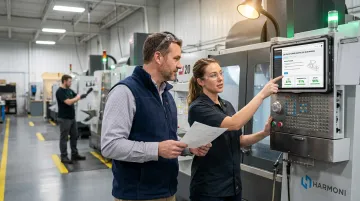
This step is cultural, not structural. It requires sustained modeling from the top, not a one-time training session.
Step 3 — Implement Visual Management and Metrics
Once communication habits are established, expand the visual system and formalize metrics tracking. Three metrics cover the most critical dimensions of production health to start:
- OEE — captures availability, performance, and quality in a single number
- First-Pass Yield — flags quality escapes before they compound downstream
- Downtime minutes — creates urgency around equipment reliability at the team level
Resist the impulse to launch ten KPIs at once. More metrics without established review habits creates data overload, not clarity.
Step 4 — Embed Continuous Improvement as a Daily Habit
Once communication, leadership behaviors, and visual management are running consistently:
- Introduce a Kaizen suggestion system with a visible submission and response process
- Run one focused improvement event per month targeting a specific constraint
- Post before/after results publicly, crediting the team members involved
When operators see their ideas implemented and improvement is built into the normal week — not treated as a separate initiative — engagement compounds. Each completed Kaizen becomes evidence that the system works, which drives the next one.
Key Metrics That Reflect a Healthy Lean Shop Floor Culture
The right KPIs measure both operational performance and cultural health — they aren't the same thing.
Operational Indicators
| Metric | What It Measures |
|---|---|
| OEE (Availability × Performance × Quality) | Overall machine and process effectiveness |
| First-Pass Yield | Percentage of units completed without rework |
| Scrap Rate | Material and labor lost to defective output |
| Downtime Minutes | Lost production time by cause category |
| Lead Time | End-to-end production cycle time |
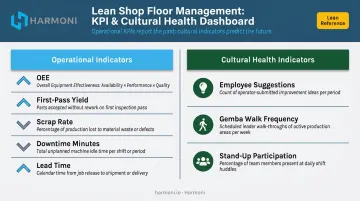
Display these in a cascading system: workstation → department → plant. This allows plant managers to see trends while operators see the numbers that directly reflect their daily work.
A NIST case study shows what focused FPY work can achieve: first-pass yield climbed from 10% to 90%, and processing time dropped from 11.8 hours to 3.4 hours.
Cultural Health Indicators
Track these leading indicators:
- Employee improvement suggestions submitted and implemented — declining submission rates signal psychological safety problems before OEE reflects them
- Gemba walk frequency and quality — tracked as scheduled vs. completed
- Stand-up participation rates — consistent low participation indicates disengagement
These metrics predict trajectory. Operational KPIs report on the past; cultural indicators show where things are heading before performance data catches up.
Review Cadence
Knowing which metrics to track only matters if teams review them consistently:
- Daily: Operational adjustments — respond to yesterday's gaps today
- Weekly: Trend analysis and problem escalation — identify patterns, not just incidents
- Monthly: Evaluate whether improvement initiatives are delivering results
Skipping reviews sends its own signal. When improvement meetings get cancelled while production meetings never do, teams draw the obvious conclusion: improvement is optional.
Technology's Role in Sustaining Lean Shop Floor Management
Digital tools don't replace lean culture. They amplify it, but only after the foundational habits are established.
What Technology Adds
Manual visual boards have real limits. They require someone to update them, can't surface exceptions automatically, and can't integrate data from machines, operators, and ERP systems simultaneously. When communication habits and leadership behaviors are already running, technology removes those constraints.
Factory orchestration platforms like Harmoni connect ERP systems, MES platforms, operators, and machines — giving supervisors an integrated view of floor activity in real time, not after the shift ends.
Specific capabilities that support lean SFM:
- Real-time OEE dashboards accessible from any device, reflecting actual machine and production status
- Visual Factory andon-style indicator lights that surface problems the moment they occur — not at shift debrief
- Automated alerts that notify supervisors of exceptions as they emerge, enabling immediate corrective action
- RFID-based automation that eliminates manual, non-value-added steps: operators are identified automatically, the correct program and work instructions load, and labor time records without manual entry
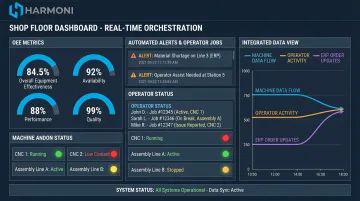
Harmoni's platform connects ERP systems, shop floor systems, and CNC machine controls into one unified view — linking machines, operators, jobs, and ERP transactions. This directly enables Genjitsu (facts-based decision making) at scale: every daily stand-up decision is anchored to verified, real-time data rather than recalled impressions.
The Sequencing Caution
McKinsey's research on digital manufacturing found that roughly two-thirds of industrial companies had piloted digital solutions but fewer than one-third had scaled them — because technology deployed without the operating-model foundation to support it stalls in pilot purgatory.
A team that already reviews daily metrics, escalates problems consistently, and follows defined standard work is ready for digital amplification. A team that doesn't yet have those habits will find that more data creates more confusion, not more clarity.
Frequently Asked Questions
What are the principles of lean shop floor management?
Lean SFM is built on going to the Gemba (managing at the point of work), basing decisions on real data (Genjitsu), standardizing work and confirming process adherence, making performance visible through structured boards, and building continuous improvement into daily routines rather than treating it as a separate initiative.
What are the C's of lean shop floor management?
The commonly referenced C's in lean SFM are Commitment, Communication, Consistency, Continuous Improvement, and Culture. These five behavioral pillars must be modeled by leadership daily — when any one lapses, SFM tools degrade into compliance theater rather than genuine improvement discipline.
What is the difference between shop floor management and lean manufacturing?
Lean manufacturing is the broader philosophy — eliminating waste, improving flow, building pull systems. Shop floor management is the daily operational discipline that applies those principles through structured leadership behaviors, visual tools, and communication routines. In practice, lean defines what to pursue; SFM is the operational system that makes it happen on every shift.
How long does it take to build a lean culture through shop floor management?
Visual boards and daily stand-ups can show operational results within weeks. Genuine cultural adoption — where frontline workers proactively surface problems without prompting — typically requires 6–12 months of consistent leadership behavior. The timeline depends far more on leadership consistency than on tool selection.
What tools are essential for getting started with shop floor management?
Start with three: a visual SFM board tracking 2–3 key metrics, a standardized daily stand-up agenda with a fixed 10-minute time limit, and a simple problem-escalation process with clear ownership. These require minimal investment and establish the visibility and communication habits every other SFM practice depends on.