

Introduction
Aerospace manufacturing operates under a simple, unforgiving rule: components either meet specification or they don't. There is no acceptable middle ground when a structural fastener, engine component, or avionics part fails at altitude.
Traditional quality control — paper travelers, manual inspection logs, periodic audits — was built for a slower era. Today's aerospace supply chains span dozens of suppliers across multiple continents, tolerances are measured in microns, and regulators demand complete traceability from raw material to finished part. Paper-based systems weren't designed for that scale.
The shift to digital quality control moves aerospace manufacturers from reactive, post-production defect detection to real-time monitoring across the shop floor, supply chain, and inspection workflow. The cost of catching problems late is steep. When RTX disclosed a rare powder-metal condition in Pratt & Whitney GTF engines in 2023, the estimated pre-tax operating profit impact reached $3B–$3.5B — a figure that defines exactly what's at stake.
This guide covers why digital QC matters in aerospace, the regulatory standards that shape it, actionable best practices, shop floor execution challenges, and how to integrate quality tools with ERP and MES systems.
Key Takeaways
- A single quality escape in aerospace can trigger fleet-wide recalls costing billions — prevention always costs less than correction
- Digital QC shifts defect detection from final inspection to in-process monitoring, compressing correction cycles from days to minutes
- AS9100, FAA Part 21, and EASA Part 21 mandate complete, auditable quality records that paper systems can't reliably produce
- Real-time shop floor observability — knowing who is running what job on which machine — is foundational to preventing defects at their source
- Bidirectional ERP and MES integration turns inspection data into operational intelligence
Why Digital Quality Control Is Critical in Aerospace Manufacturing
The Cost of Getting It Wrong
The RTX/Pratt & Whitney GTF example isn't an outlier — it's a preview of what insufficient process control looks like at scale. Boeing separately paused 787 deliveries in 2020 due to production quality issues, with the DOT Inspector General reporting FAA-mandated inspections in December 2021 and significant rework required across the fleet. The result: grounded aircraft, halted production lines, and regulatory scrutiny that shadows a manufacturer's reputation for years.
Unlike most industries, aerospace offers no tolerance for acceptable defect rates. A stamped metal bracket in consumer electronics can fail without consequences. The same part on a commercial aircraft cannot.
Where Traditional QC Falls Short
Paper-based quality control has a structural flaw: it discovers problems after they've already occurred. An operator completes a batch, a quality technician reviews the paper traveler, and a nonconformance is logged — often hours or days after the defective parts left the machine.
By then, the process deviation may have repeated dozens of times and the rework cost has already compounded.
Digital QC systems invert this model. Sensors, connected machines, and digital inspection workflows generate continuous data streams. Anomalies surface in real time, and the window between defect introduction and detection compresses from shifts to minutes.
The Workforce and Supply Chain Dimensions
Two additional factors reinforce why digital QC has moved from competitive advantage to operational requirement:
- Workforce expectations: A new generation of manufacturing professionals expects digital tools that provide immediate feedback. Paper-based workflows create friction, increase error rates, and slow execution.
- Supply chain complexity: Aerospace supply chains are multi-tiered and global. Digital traceability ensures consistent quality standards across every supplier and sub-tier — something paper systems fundamentally cannot guarantee.
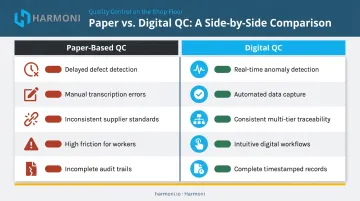
Both pressures point to the same conclusion: closing the digital gap is a competitive and compliance imperative. According to McKinsey and the AIA, digital maturity and scaling gaps persist across more than 70 aerospace and defense companies — manufacturers that address this now will hold a measurable advantage over those that wait.
Key Regulatory Standards Every Aerospace Manufacturer Must Meet
Digital QC systems must be designed around compliance requirements first — production efficiency follows. Here's what aerospace manufacturers are actually required to meet.
The Core Standards
| Standard | Scope | Key Requirement |
|---|---|---|
| AS9100 Rev D (9100:2016) | Aviation, space, and defense QMS | Built on ISO 9001:2015 with aerospace-specific additions; governs documentation, risk management, and product realization |
| FAA Part 21 | U.S. production certification | 14 CFR 21.137 requires a documented quality system ensuring each product conforms to approved design and is in condition for safe operation |
| FAA Part 145 | U.S. repair stations | Requires a quality-control system acceptable to the FAA |
| EASA Part 21 | European production organizations | Production Organisation Approvals govern conformity of products, parts, and appliances |
| DFARS/DCMA | U.S. defense contractors | Part 246 and DCMA surveillance manuals cover contractor quality assurance |
FAI, APQP/PPAP, and NCR Requirements
Three process-level standards define how quality is documented through the production lifecycle:
- First Article Inspection (AS9102C): Formal verification that the first manufactured part meets all engineering requirements before production begins
- APQP/PPAP (AS9145): Structured quality planning and production part approval — RTX uses PPAP as a phase gate in its APQP process
- Non-Conformance Reporting (NCR/CAPA): AS9100:2016 maps specific clauses for nonconforming output control and corrective action workflows
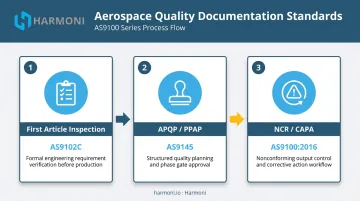
Digital systems that automatically populate FAI documentation, timestamp inspection results, and maintain revision-controlled records prevent audit failures caused by missing or illegible paper records. Regulators expect complete, timestamped documentation that supports traceability in any field issue — and that standard applies equally whether you're facing an FAA audit or a DCMA surveillance review.
Best Practices for Digital Quality Control in Aerospace Manufacturing
Effective digital QC in aerospace rests on three interconnected practice areas: real-time monitoring and data collection, predictive quality management, and digital traceability.
Real-Time Monitoring and Data Collection
The traditional QC model samples periodically. Digital QC monitors continuously.
Embedding sensors and IoT-connected devices at critical production points captures key parameters (dimensional measurements, surface quality, temperature, pressure, process timing) in real time. As Airbus has noted, industrial IoT and advanced analytics are boosting aerospace manufacturing efficiency by transforming QC from a sampling exercise into continuous oversight.
Statistical Process Control (SPC) takes on new power in a digital context:
- Streaming measurement data enables automatic Cpk calculation
- Process drift is detected before nonconforming parts are produced
- Out-of-control alerts fire at the machine level, not during final inspection
The difference matters enormously. Discovering a Cpk problem during batch review means scrapping completed parts. Discovering it during production means adjusting the process and saving the batch.
Harmoni's platform supports this approach through digital checksheets at each CNC machine terminal. Operators enter inspection data directly at the machine (or capture it automatically via Bluetooth-integrated measuring tools) and the system visualizes measurement trends in real time, flagging when data begins moving toward tolerance limits before a quality event occurs.
Predictive Quality Management with AI and Machine Learning
Machine learning adds a forward-looking layer that traditional SPC cannot provide. Algorithms trained on historical production and inspection data identify patterns that precede defects, enabling quality teams to intervene before nonconformances occur rather than reacting after the fact.
The aerospace industry's largest manufacturers have committed to this approach:
- Rolls-Royce reported its Intelligent Borescope can reduce aircraft engine inspection time by 75% and save up to £100M over five years
- GE Aerospace deployed an AI-enabled inspection tool in 2025 to improve inspection accuracy and consistency for narrowbody engine components
- Raytheon (RTX) is using data and AI to speed first article inspection
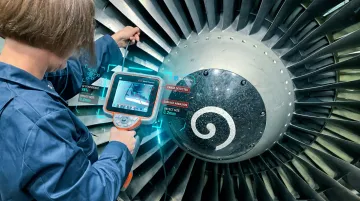
Predictive quality tools shift aerospace QC from reactive inspection to proactive prevention. Prevention consistently costs a fraction of what post-production rework and field corrections require — that financial logic is hard to ignore.
Digital Traceability and Documentation
NIST defines a digital thread as continuous, lifecycle-spanning traceability of information covering engineering requirements, production steps, in-process inspections, and final acceptance. In aerospace, this means every part can be traced back to its exact manufacturing conditions at any point in its lifecycle.
The NIST Model-Based Definition (MBD) framework uses 3D models as the central knowledge artifact for product data replacing or augmenting 2D drawings with a single authoritative source that feeds directly into production and inspection workflows.
Digital documentation eliminates the paper-based risks that have caused real compliance failures:
- Lost travelers that break part history chains
- Unauthorized markups that introduce undocumented revision conflicts
- Illegible inspection records that fail audit review
- Missing revision histories that delay FAI packages and PPAP submissions
For regulatory audits, a complete digital record that auto-populates from production data is far more reliable than a stack of manually completed forms.
Real-Time Process Control and Error Prevention on the Shop Floor
The Execution Gap
Even the best digital QMS or ERP system has a blind spot: what actually happens at the workcenter. The moment between receiving a digital work instruction and correctly executing the task is where a significant share of nonconformances originate.
Wrong tooling, skipped inspection steps, misread specifications, incorrect program selection — these errors are invisible to ERP and QMS systems until a part fails inspection or a nonconformance is filed.
The Aerospace Corporation has reported that human error contributes to over 50% of errors in aerospace manufacturing. NASA's Human Error Analysis guidance treats error identification at each task step as the foundation of human risk assessment. The numbers are consistent: execution-layer errors are the dominant quality risk on the shop floor, and they require execution-layer solutions.
Centralized Workcenter Command Centers
Operators need the right information at the right moment — without leaving the machine to find it.
Harmoni places a centralized command center at each CNC machine. When an operator approaches, RFID identification automatically detects the employee and job, then surfaces the correct work instructions, setup sheets, and quality checksheets for that specific part and revision. The correct CNC program, settings, and offsets load onto the machine automatically. Nothing is manually selected. Nothing is pulled from a binder.
That eliminates the entire category of errors that stem from operators working from outdated or incorrect documentation.
This matters in aerospace because revision control failures are a direct compliance risk. An operator running a superseded program or an old setup sheet isn't just making a quality mistake — they're potentially creating an airworthiness issue.
Automated Error-Proofing and Real-Time Observability
Preventing errors at the source requires more than displaying instructions. It requires:
- Quality gates that capture required inspection data before production can advance
- Visual alerts when measurements trend toward tolerance limits
- Bluetooth-integrated measuring tools that eliminate manual transcription errors
- Timestamped records of every operator action, program load, and quality entry
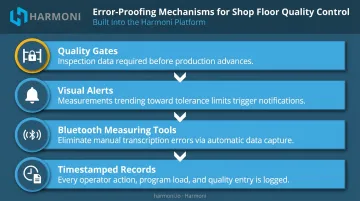
Harmoni creates this layer of observability across the shop floor. Quality managers and supervisors can see, in real time, which operator is running which job on which machine — and whether the process is performing within specification. Exception alerts surface immediately, not during the next shift review or weekly quality meeting.
That same accountability layer does double duty: it catches deviations before they become nonconformances, and it generates the timestamped audit record that AS9100, FAA Part 21, and DCMA surveillance requirements demand.
Tracking the Right KPIs for Digital Quality Control Performance
Digital QC systems generate far more data than traditional inspection. Without a defined set of KPIs, that data becomes noise rather than intelligence.
Critical Quality KPIs
| KPI | What It Measures |
|---|---|
| First Pass Yield (FPY) | Percentage of parts completing production without rework or rejection |
| Defect Rate (PPM) | Defective parts per million produced |
| Process Capability (Cpk) | Statistical measure of how well a process performs within specification limits |
| Scrap and Rework Rate | Material and labor cost consumed by nonconforming production |
| Non-Conformance Rate (NCR) | Frequency of documented quality escapes |
| On-Time Inspection Completion | Whether required inspections are completed within the production timeline |
From Data to Action
Real-time KPI dashboards shift quality management from monthly reporting to continuous monitoring. When a workcenter's FPY begins declining mid-shift, a quality manager can investigate and intervene before the trend becomes a batch rejection. When Cpk for a critical dimension drops below threshold, the alert fires at the machine — not three days later during a quality review.
The most financially revealing KPI is cost of poor quality (COPQ): scrap material, rework labor, schedule impact, and customer escapes translated into a dollar figure. This is the metric that builds the business case for investing in preventive digital QC capabilities.
Harmoni's integration with ERP systems (Epicor, Infor, JobBoss, and others) supports this connection by capturing scrap quantities, labor records, and production data at the machine and pushing them directly into job costing workflows.
Integrating Digital Quality Control Tools With ERP and MES Systems
Why Integration Is Non-Negotiable
A digital QC tool that operates in isolation from ERP and MES systems creates a new problem: siloed quality data. Inspection results sitting in standalone software don't automatically update job costs, populate compliance documentation, or feed corrective action workflows. The quality record exists, but the operational system of record doesn't reflect it.
Bidirectional integration means shop floor inspection data updates ERP records in real time, while ERP job and routing data drives the correct quality requirements at each machine.
Bridging the ERP/MES Data Gap
Most ERP and MES systems lack the granularity to capture real-time shop floor quality events. They know a job was completed; they don't know whether the operator used the correct tooling, whether the in-process inspection was performed, or whether measurements trended toward the tolerance limit before an adjustment was made.
That data gap is where quality problems hide. Harmoni's factory orchestration layer sits between machines, operators, and enterprise systems — collecting real-time machine data, operator activity, and quality inspection results, then feeding that data back to ERP systems and surfacing it in shop floor dashboards. The result is end-to-end visibility that ERP alone cannot provide.
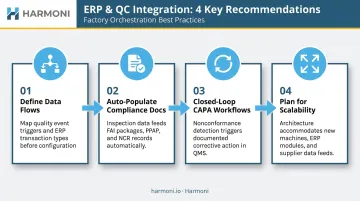
Four Recommendations for Successful ERP/QC Integration
Define data flows before implementation — Map quality event triggers, data fields, and ERP transaction types before configuring any integration. Retrofitting data architecture is significantly more expensive than planning it correctly upfront.
Auto-populate compliance documentation — Inspection data captured on the shop floor should automatically populate FAI packages, PPAP submissions, and NCR records. Manual re-entry is a traceability risk and a waste of quality engineer time.
Build closed-loop CAPA workflows — Nonconformance detection on the shop floor should trigger a documented corrective action workflow in the QMS. The AS9100 clause structure for nonconforming output control and corrective action requires this connection.
Plan for scalability — Integration architecture should accommodate new machine types, additional ERP modules, and supplier quality data feeds as the operation grows. Point-to-point integrations that work for today's configuration often break when the operation expands.
Frequently Asked Questions
What is digital quality control in aerospace manufacturing?
Digital quality control uses connected sensors, software systems, and data analytics to monitor, verify, and document product quality in real time throughout the manufacturing process. It replaces or augments manual inspection with automated, data-driven oversight that improves accuracy, traceability, and compliance documentation.
What quality standards govern aerospace manufacturing quality control?
AS9100 Rev D is the primary aerospace quality management standard, built on ISO 9001:2015 with aerospace-specific additions. U.S. manufacturers also comply with FAA Part 21, while defense contractors must address DFARS Part 246 and DCMA surveillance requirements.
How does real-time monitoring improve quality control in aerospace?
Real-time monitoring captures process drift, dimensional deviations, and parameter exceedances as they occur — compressing the detection-to-correction cycle from days to minutes. Problems get caught while the process can still be adjusted, not after a batch of nonconforming parts is already complete.
What role does AI play in aerospace quality control?
AI and machine learning analyze historical and real-time production data to predict where defects are likely to occur, enabling preventive action before nonconforming parts are produced. Rolls-Royce demonstrated a 75% reduction in engine inspection time with AI-powered borescope technology, and GE Aerospace deployed AI inspection tools for narrowbody engine components in 2025.
What KPIs should aerospace manufacturers track for digital quality control?
The most critical KPIs are First Pass Yield, defect rate (PPM), process capability (Cpk), scrap and rework rate, Non-Conformance Rate, and cost of poor quality. Real-time dashboards make these metrics actionable at the machine and shift level — enabling targeted intervention rather than retrospective reporting.
How can aerospace manufacturers integrate digital quality control with their ERP systems?
Start with bidirectional data integration so inspection results auto-populate compliance documentation without manual re-entry, and build closed-loop CAPA workflows connecting shop floor nonconformance detection to QMS corrective action. A factory orchestration platform like Harmoni connects enterprise ERP systems to real-time shop floor execution, providing the visibility that ERP alone cannot deliver.